Research catalogue
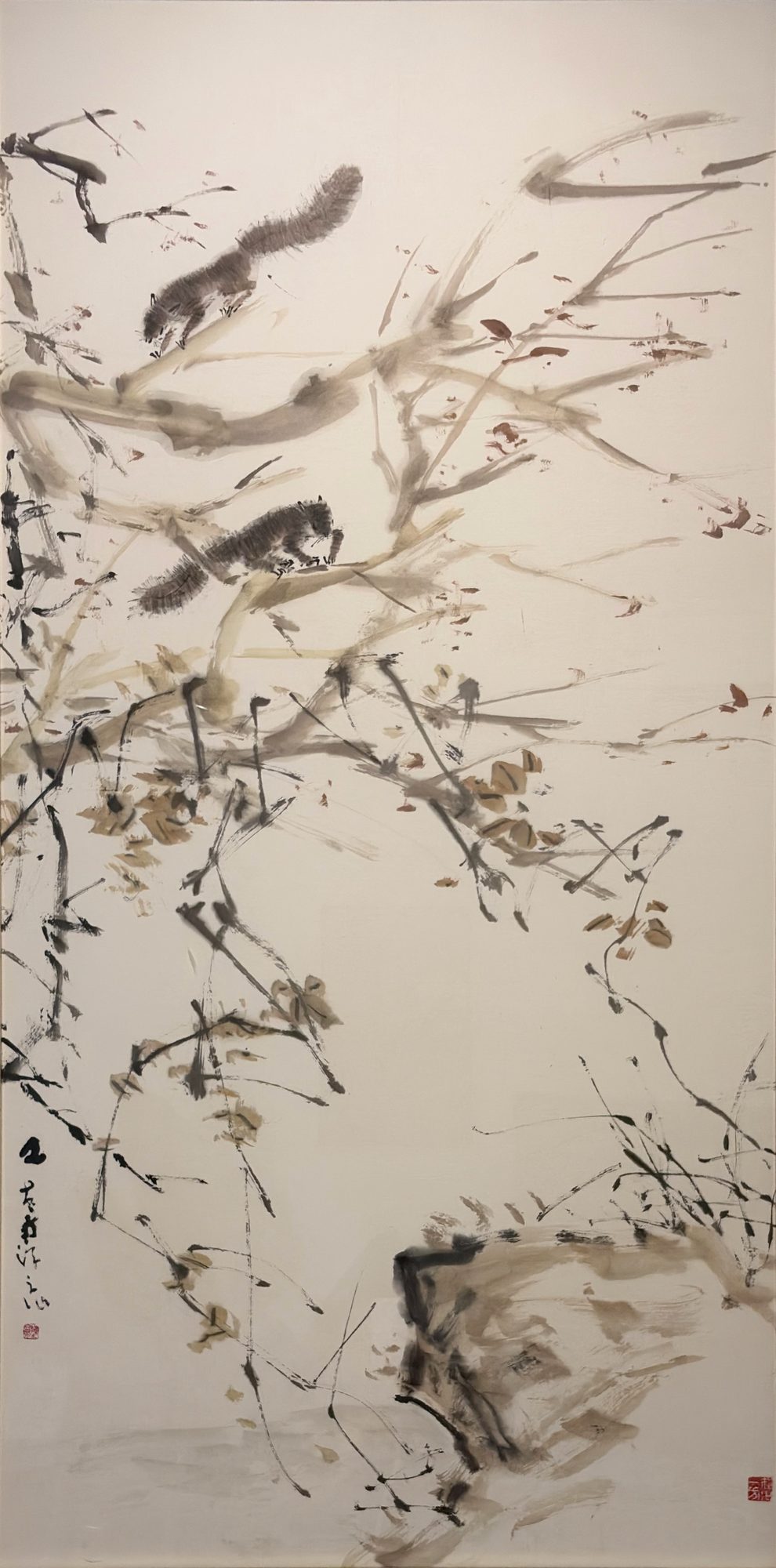
This entry examines Squirrels amidst Autumn Leaves through its inscription and reported provenance, its composition and use of unpainted paper, and the range of brushwork with which Chen Wen Hsi renders animals, branches and foliage. It considers how a later work reinterprets the conventions of Chinese ink painting through a modern sensibility.
Object, Inscription and Provenance
Dated to the 1980s, Squirrels amidst Autumn Leaves belongs to the later phase of Chen Wen Hsi's career, when ink painting became an increasingly important focus of his practice. Known for his depictions of animals, Chen used expressive brushwork to transform familiar natural subjects into more dynamic compositions. In his later works, animals and trees became elements in arrangements of lines, tonal areas and space, rather than simply subjects of naturalistic description. This approach is evident in the arrangement of branches, foliage and animals in the painting.
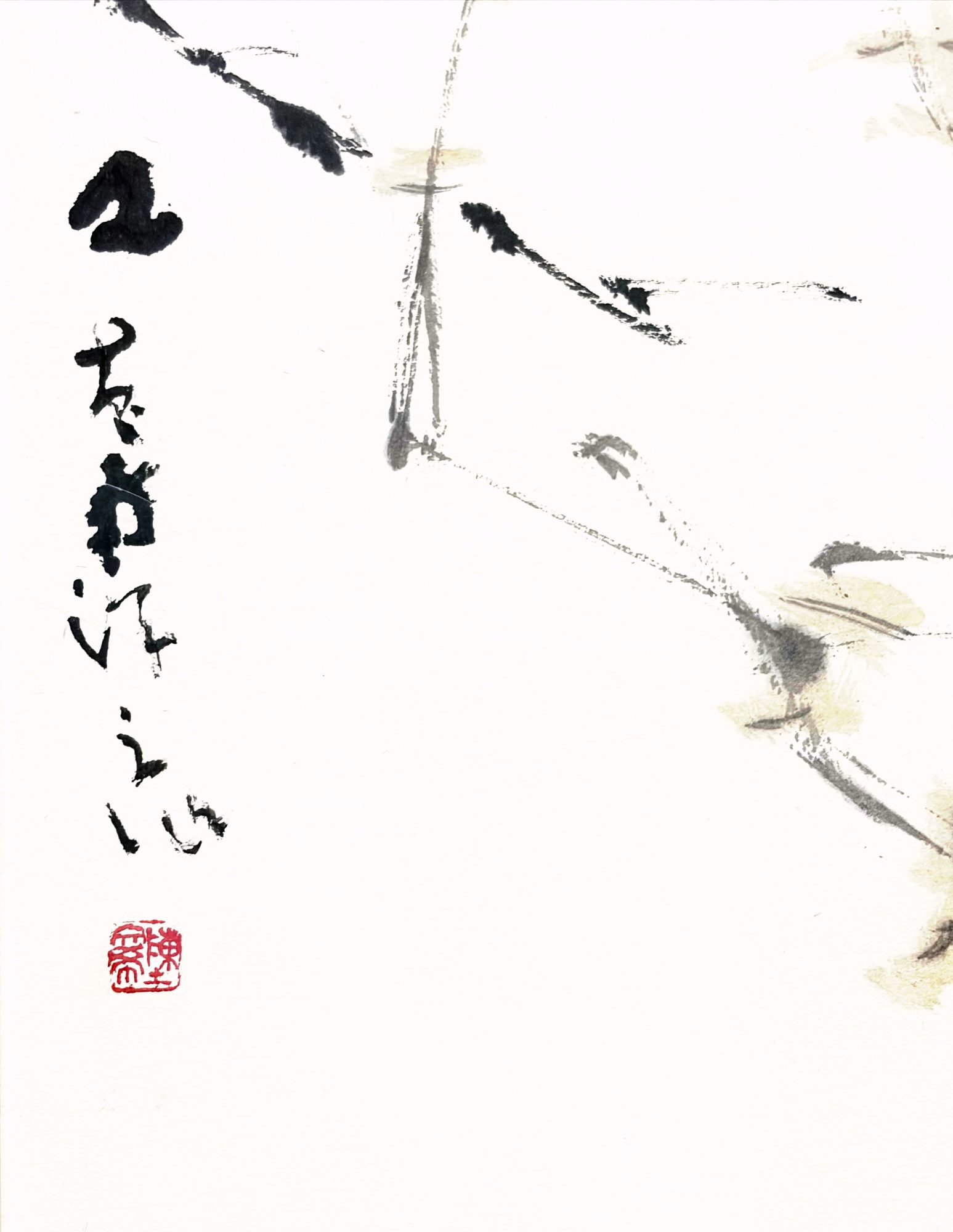
The inscription, transcribed as 文希南洋之作, provides a point of reference to the work's regional context. '文希' refers to Chen Wen Hsi by his artistic name, while '南洋' denotes the Nanyang region, commonly associated with Southeast Asia. The inscription may provisionally be translated as 'A Nanyang work by Wen Hsi'. National Gallery Singapore records a separate work, Swans (1987), bearing a similar, though not identical, inscription 文希南洋作. This parallel offers a useful comparison with Chen's practice, without establishing that the two inscriptions carry precisely the same meaning.
Beyond the inscription, the painting's provenance provides another point of reference for its history. The painting was formerly in the collection of Dr Earl Lu, a particularly relevant figure in the context of Chen's artistic legacy. As documented in A Case Study of Art Patronage, Lu was an important early supporter of Chen, purchasing his works and introducing him to other collectors. Their relationship extended beyond collecting: by the 1980s, Chen reportedly presented Lu with a favourite painting each year as a Chinese New Year gift. The National Gallery Singapore also records several works by Chen, including Two Gibbons midst Vines and Narcissus, as gifts from Lu. Together, these accounts place the painting's reported provenance within a wider network of friendship, patronage and personal exchange that shaped the circulation of Chen's works.
Visual Analysis: Composition and Pictorial Structure
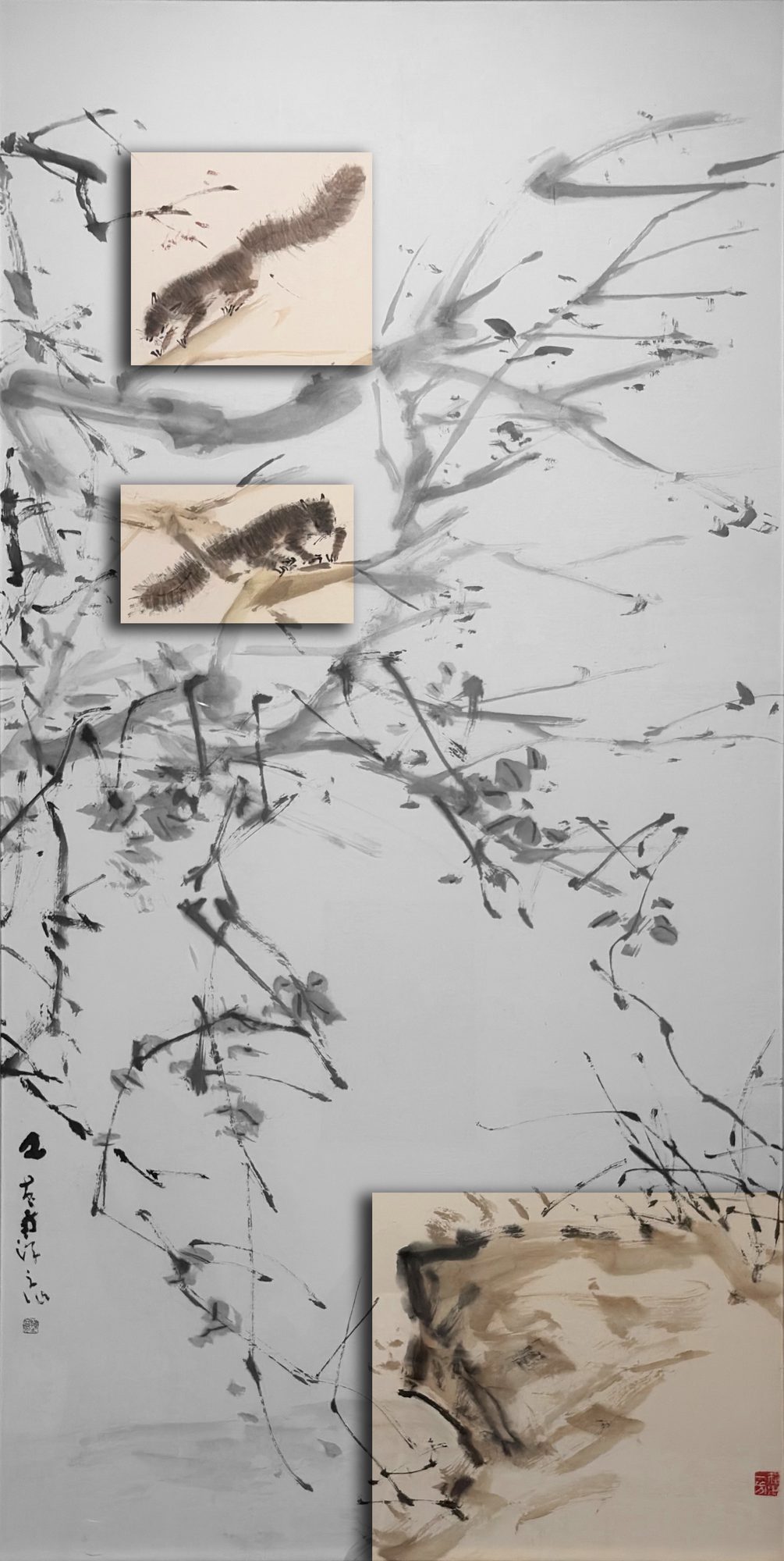
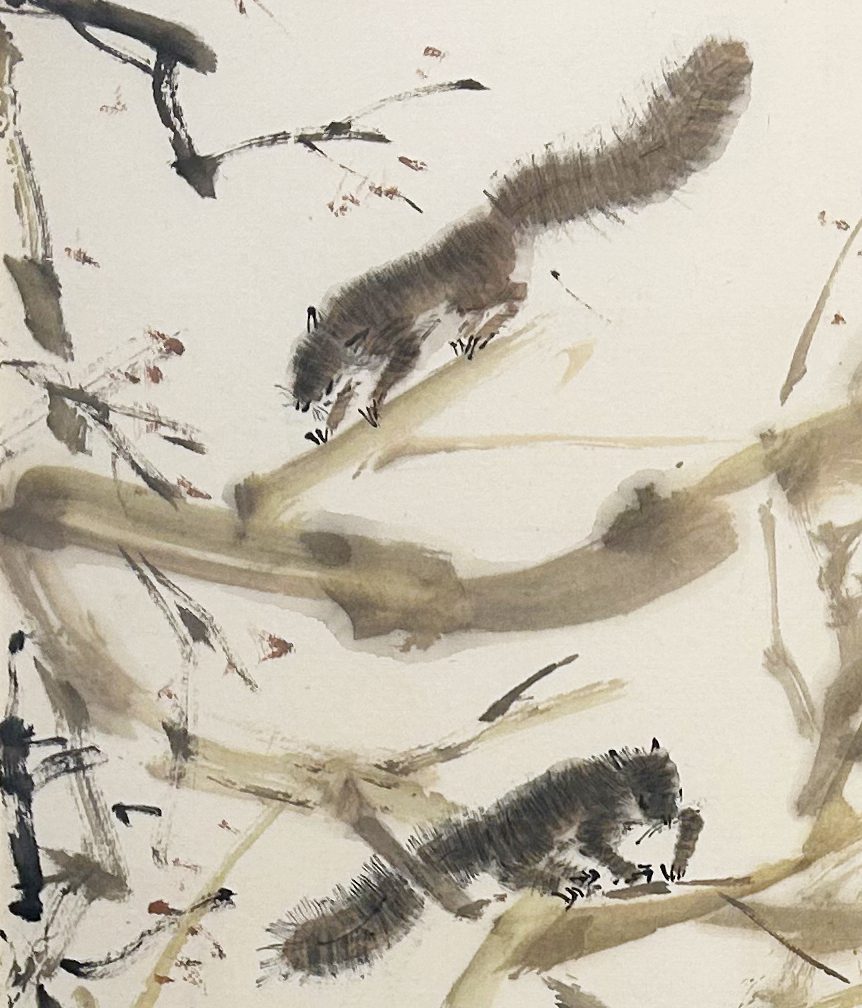
Two squirrels cling to the branches, one stretched along a higher branch and the other crouched below, their agile bodies and alert postures lending the scene a sense of precarious liveliness, as though they are bracing against a strong gust of wind. Their contrasting postures invite a question: will they venture further along the swaying branches, or wait for the wind to pass? A few leaves cling to the twigs, while the rugged rock below sits quietly beneath the restless scene above.
Despite this apparent restlessness, the composition remains balanced. The squirrels occupy different positions within the network of branches and foliage, distributing visual interest across the vertical picture plane rather than concentrating it at a single focal point.
The squirrels' compact bodies and textured coats stand out against the branches' elongated lines. Positioned within this network, they interrupt and redirect the flow of the foliage, creating points of visual emphasis and establishing a dynamic counterpoint to the branches' linear structure.
The intersecting, angular branches establish the composition's principal directional structure, guiding the eye diagonally and laterally across the sheet and counteracting its vertical format. In the lower right, the substantial rock anchors this network. Its mass contrasts with the finer twigs and scattered foliage, counterbalancing the branches' directional movement and lending the composition stability without diminishing its visual energy.
The Expressive Power of Empty Space
The interplay between the branches, foliage and rock is further shaped by the substantial areas of exposed paper between the painted forms. These spaces preserve openness around the animals and vegetation, allowing the forms to remain distinct without enclosing them within a continuous setting. The unpainted paper thus gives the composition room to breathe.
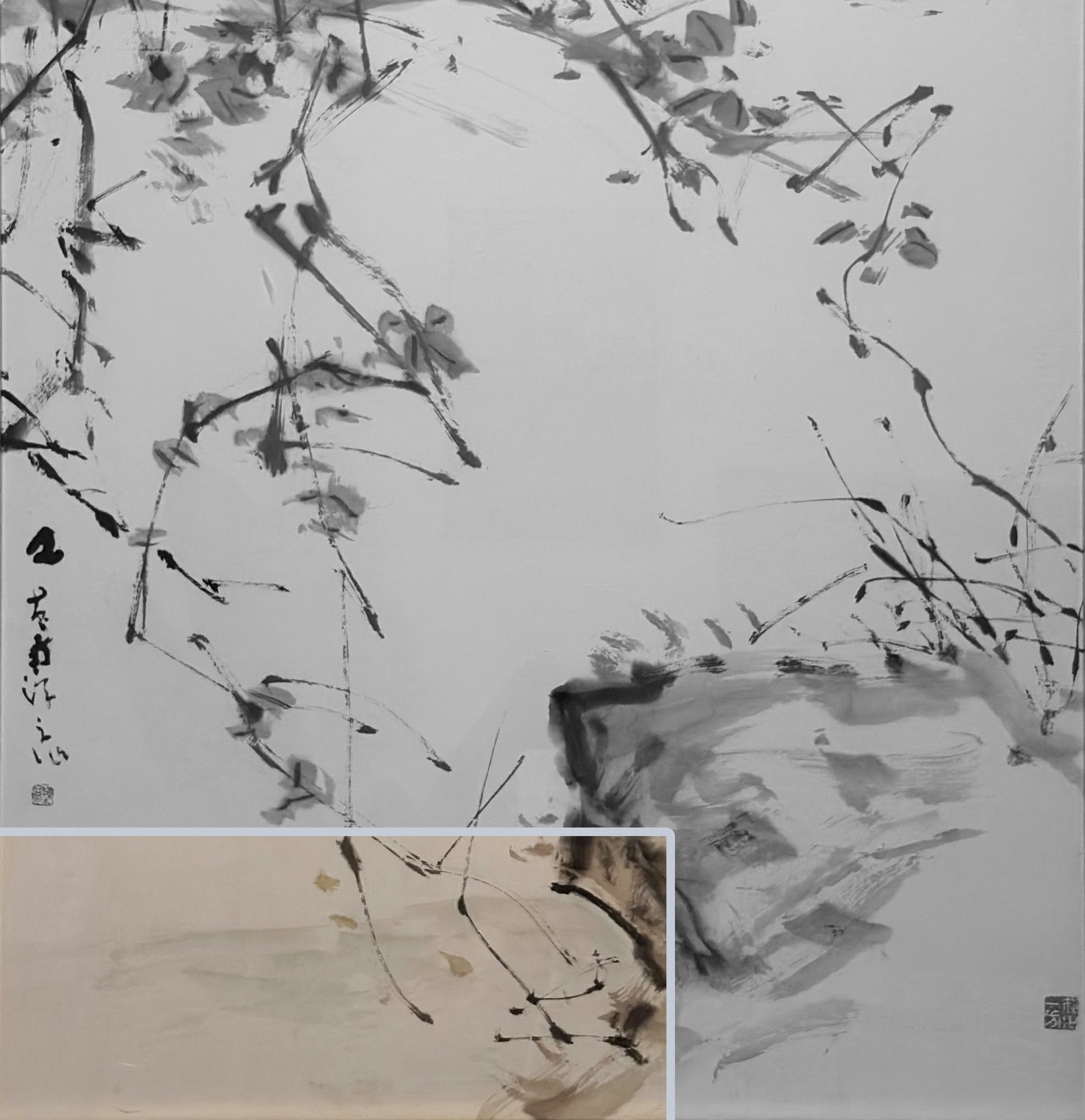
This use of unpainted space may be understood in relation to liu bai (留白), the deliberate retention of unpainted areas in Chinese painting. The paper becomes integral to the work's spatial and expressive structure. The intervals between the animals, twigs and clusters of leaves suggest a landscape only partially articulated, inviting the viewer to imagine what the brushwork leaves undefined.
The expressive potential of this restraint is particularly evident in the faint horizontal strokes along the lower-left edge of the open area, which suggest water. These delicate marks establish the character of a water surface without fully defining its extent. The surrounding paper allows the water to be apprehended as an expanse beyond the brushwork, making the unpainted area an active element in the evocation of landscape.
Colour, Tone and Visual Emphasis
Beyond the expressive use of exposed paper, Chen shapes the painting's pictorial structure through a restrained palette of grey-black ink, warm beige and taupe washes, and ochre-brown accents. Within this limited range, subtle variations in the squirrels' grey-brown colouring distinguish the upper figure's slightly warmer cast from the lower figure's marginally cooler, deeper tones (Fig. 5). Their darker colouring gives the squirrels visual prominence against the more lightly painted branches and foliage, without concentrating attention on either figure alone.
Diluted, earthy washes soften the transitions between the branches and their surroundings, while sparse ochre-brown accents introduce autumnal warmth into the foliage without overwhelming the pale ground. These restrained shifts in colour and tone lend continuity to the intersecting forms, guiding the eye between the squirrels and the vegetation while preserving the painting's overall lightness.
The two red seals provide a distinct accent within this muted palette. Positioned near the lower-left edge and the bottom-right corner, they occupy opposing sides of the lower portion of the vertical format. Their concentrated red pigment contrasts with the subdued ink and washes, while its warmth relates subtly to the ochre-brown foliage. Their placement also establishes a counterpoint to the dark mass of the rock, distributing visual weight across the lower part of the composition. Beyond their identifying function, the seals thus contribute to the painting's visual balance through the interplay of colour, position and tonal contrast.
Brushwork & Execution: Energy of the Living Line
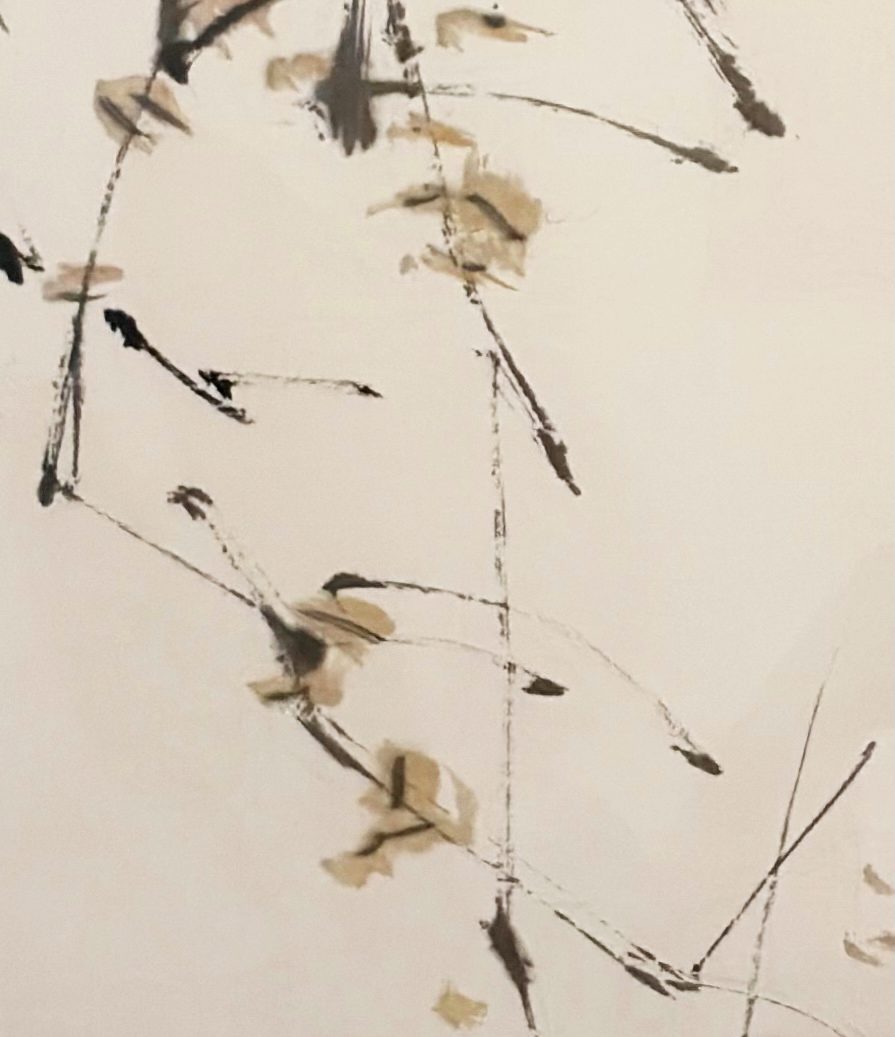
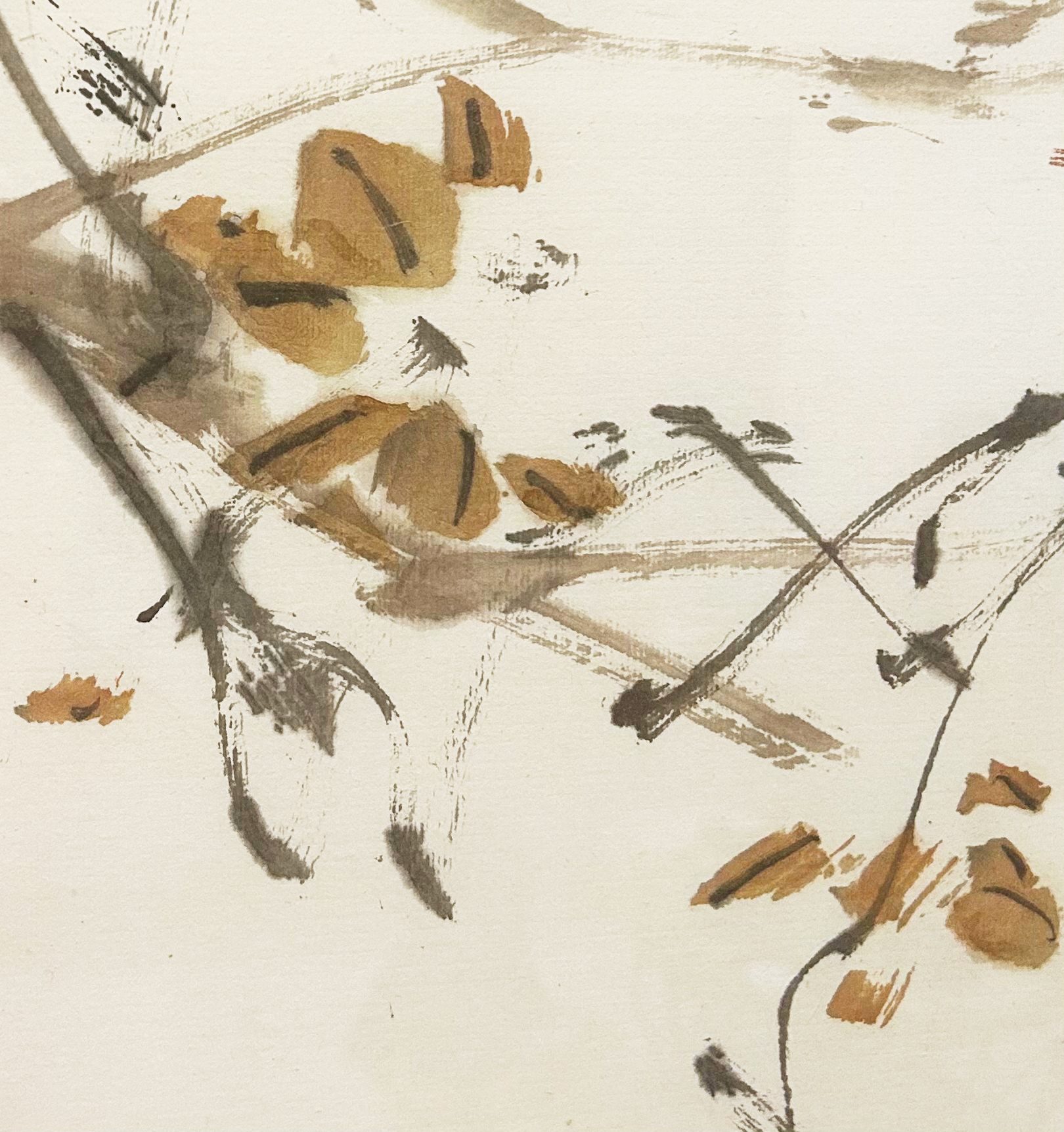
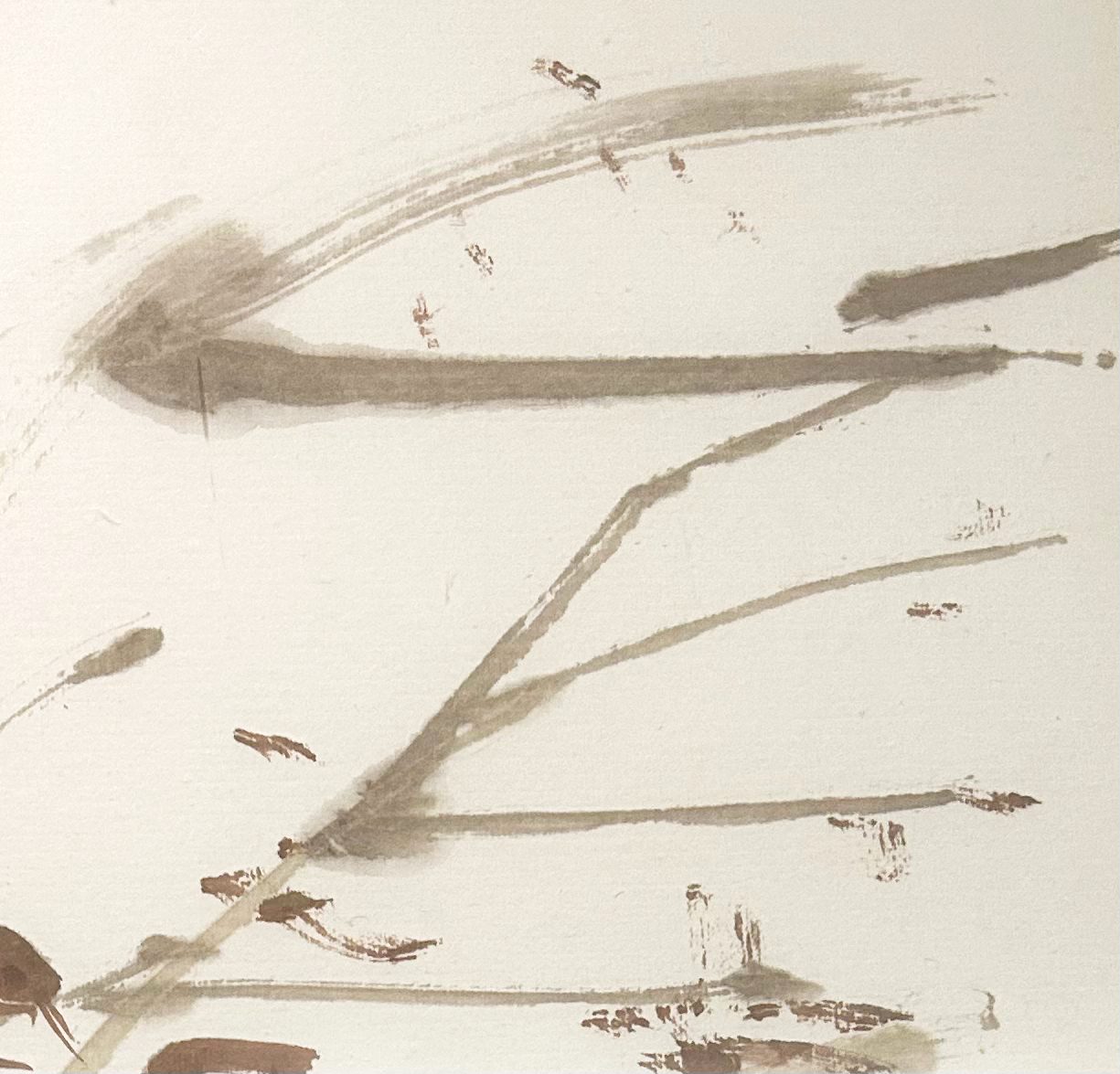
The painting's technical vitality lies in the range of effects Chen achieves through the brush, from sweeping, fluid lines to compact, densely clustered marks. Variations in stroke direction, width, density and tonal intensity distinguish the forms while animating the painted surface. Particularly striking is the contrast between continuous lines that carry movement across the composition and angular, sometimes broken marks that interrupt or redirect it. Through these contrasting modes of execution, Chen makes the brushwork both descriptive and expressive.
Chen renders the squirrels through layered ink washes and directional brushwork. Diluted grey-brown tones establish their body masses, while soft, feathered edges and subtle tonal gradations suggest the softness of their fur. Short, tapered strokes follow the contours of the bodies, gathering along the backs and bushy tails. Variations in stroke length, density and rhythm evoke the texture and direction of the fur without defining each strand individually. By contrast, concentrated, incisive marks define the eyes, paws and facial features, lending the animals greater definition. The interplay between diffused washes and precise linear accents gives the squirrels volume without rigid outlining. Where their contours soften or merge with the surrounding branches and foliage, the figures become visually integrated into the painting's wider network of lines.
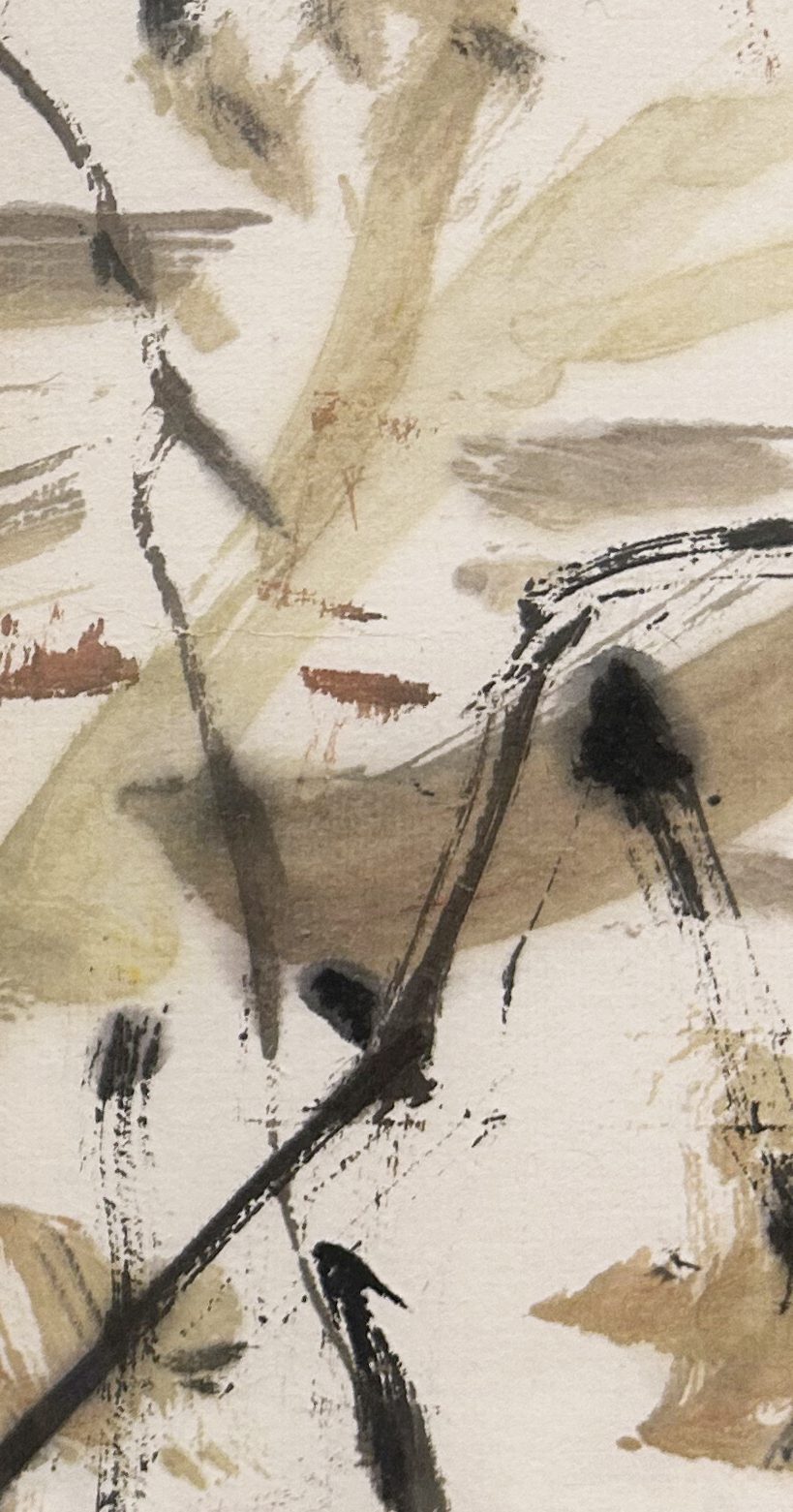
The branches provide the clearest contrast between different modes of brushwork. Long, sweeping strokes establish their principal directions, at times extending across the paper as continuous lines. Elsewhere, sharper diagonal and near-vertical strokes interrupt these passages, changing direction abruptly or breaking into fragmented edges. Broad grey-brown washes overlap with narrower, darker lines, setting softer tonal masses against more emphatic accents (Fig. 7). These shifts between continuity and interruption give the branches a sense of irregular growth while reinforcing their compositional role: their elongated lines establish directional pathways, while the angular strokes disrupt and redirect the eye's movement across the picture plane.
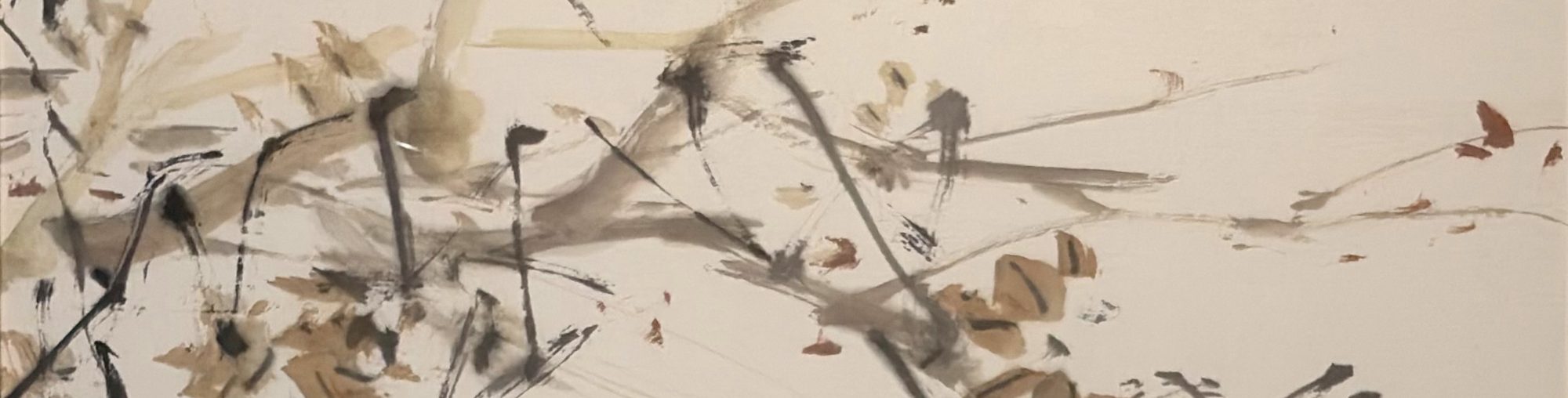
The foliage is rendered through abbreviated brushstrokes and selective applications of ink and colour. Rather than delineating individual leaves, Chen uses short, broad sweeps alongside compact, overlapping dabs to suggest clusters of vegetation, leaving their forms partially unresolved. Variations in pigment density create contrasts between darker, concentrated touches and lighter, more diffuse washes. The foliage's shorter, irregular marks distinguish it from the branches' long, sweeping strokes, establishing a contrast between clustered masses and extended linear forms. Through these variations in direction, shape and intensity, Chen conveys the density and natural irregularity of the vegetation without exhaustive delineation.
Across these different modes of execution, Chen balances textural description with the expressive force of the brush. The squirrels' layered washes and precise accents, the branches' sweeping and interrupted lines, and the foliage's abbreviated marks each serve a distinct purpose while contributing to the composition as a whole. The brushwork retains the immediacy of individual strokes, yet their varied rhythms and tonal relationships sustain the painting's visual coherence. Chen's achievement lies in conveying the character and movement of the natural world through selective, economical means, allowing the energy of the line to remain visible within the finished image.
Conclusion: Tradition, Modernity and Artistic Renewal
Squirrels amidst Autumn Leaves demonstrates Chen Wen Hsi's ability to reinterpret the traditions of Chinese ink painting through a modern artistic sensibility. Rather than abandoning established conventions, he adapts them to create a composition in which the expressive freedom of the brush coexists with structural coherence. The painting thus offers a compelling example of how an inherited artistic language can remain vital through individual transformation.
The painting's reported provenance from the collection of Dr Earl Lu adds a historical dimension to its significance, placing it within the wider networks of collecting, patronage and personal relationships that helped shape the reception of modern art in Singapore. Considered together, its artistic qualities and documented associations situate the work within both Chen's continuing engagement with Chinese ink painting traditions and the history of modern art in Singapore.
Bibliography
- National Gallery Singapore, “DBS Singapore Gallery”. Resource entry on Swans (1987).
- Academia.edu, “A Case Study of Art Patronage”. Study of Dr Earl Lu's patronage of Chen Wen Hsi.
- Culturepaedia, “Chen Wen Hsi”. Background on the artist and works recorded as gifts from Dr Earl Lu.
- Discussion of liu bai (留白), doi.org/10.1080/14702029.2023.2258048. Discussion of the concept of blank space in art.