Research catalogue
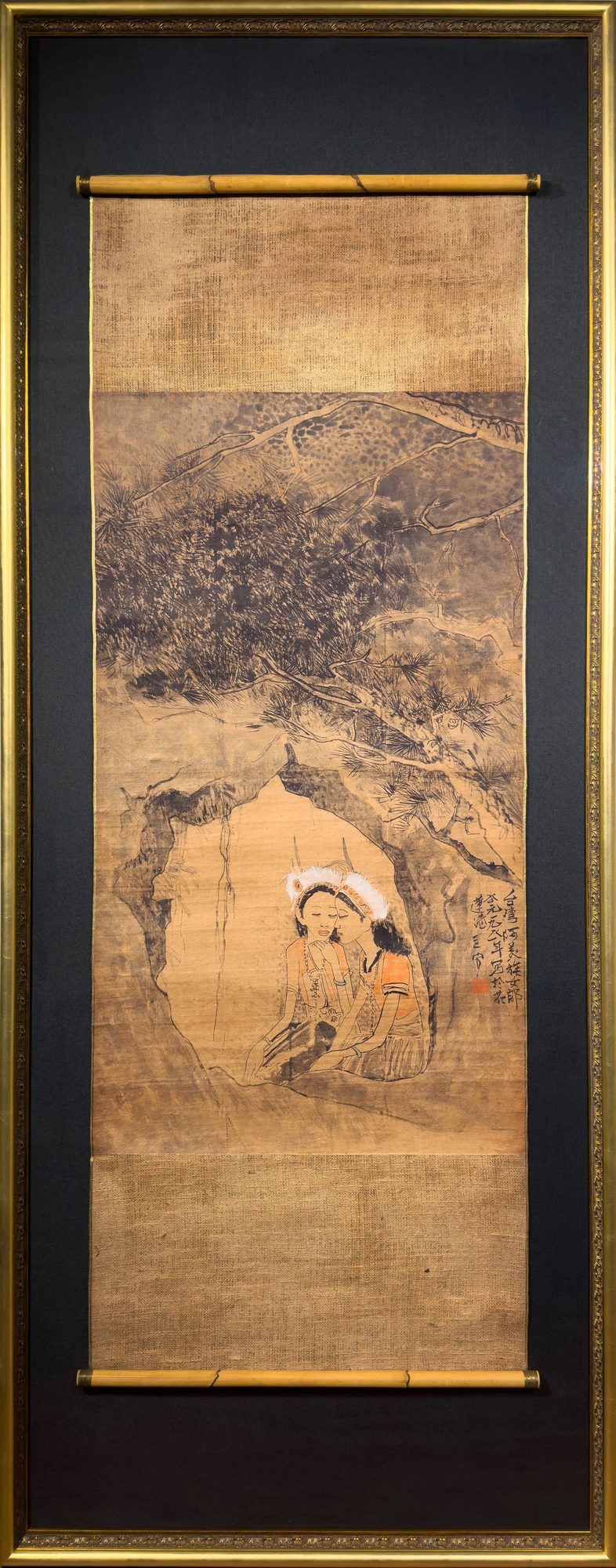
This entry examines Alishan Ladies through its inscription, published record and material construction; its composition and hanging-scroll presentation; the intimacy of its two figures; and the brushwork that shapes both the women and the surrounding landscape. It considers how Cheong Soo Pieng reinterpreted inherited Chinese pictorial conventions within a Nanyang idiom.
Object, Inscription and Publication
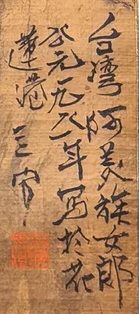
Dated 1981, Alishan Ladies belongs to Cheong Soo Pieng’s late period (1979–1983), a phase marked by a renewed engagement with Chinese ink. The painting retains characteristic features of his established visual vocabulary, including elongated limbs and almond-shaped eyes, while applying this stylisation to figures identified in the inscription (Fig. 1) as Taiwanese Amis. Its material construction is equally distinctive, combining Chinese ink and colour on rice paper laid on jute. The significance of such late works is reflected in Tan Yong Jun’s 2021 exhibition survey, which identifies Cheong’s Nanyang scrolls produced between 1978 and 1982 as “critically important to his oeuvre” and notes that they are only now being studied collectively in relation to “material culture”. This broader reassessment provides a useful context for considering how Alishan Ladies brings Chinese pictorial traditions, Indigenous Taiwanese subject matter and an unconventional support into dialogue within Cheong’s evolving Nanyang idiom.
A published record of the work appears on page 297 of Ho Sou Ping’s The Story of Cheong Soo Pieng (2nd ed., ArtCommune Gallery, 2023), where it is catalogued as item 287 under the title Untitled. The publication records the medium as ink and colour on paper mounted on cloth, lists its dimensions as 125 × 70 cm, and identifies the work as belonging to a private collection. The published image also shows the painting with its bamboo rods and gold edging. The difference between the published title, Untitled, and the title Alishan Ladies used here is significant, as it distinguishes the title recorded in the publication from the one adopted in this catalogue.
A related question concerns the identification of the figures. Although the title Alishan Ladies associates the work with Alishan, an area traditionally associated with the Tsou people, the artist’s inscription reads 台湾阿美族女郎, or Amis women from Taiwan (Fig. 1). The inscription thus introduces a discrepancy between the title used here and the artist’s written identification of the figures. While Alishan Ladies is retained as the title for this catalogue entry, the inscription provides a more specific indication of the figures’ intended identification as Amis women. The relationship between the title and the inscription remains unresolved.
Composition and Mode of Presentation
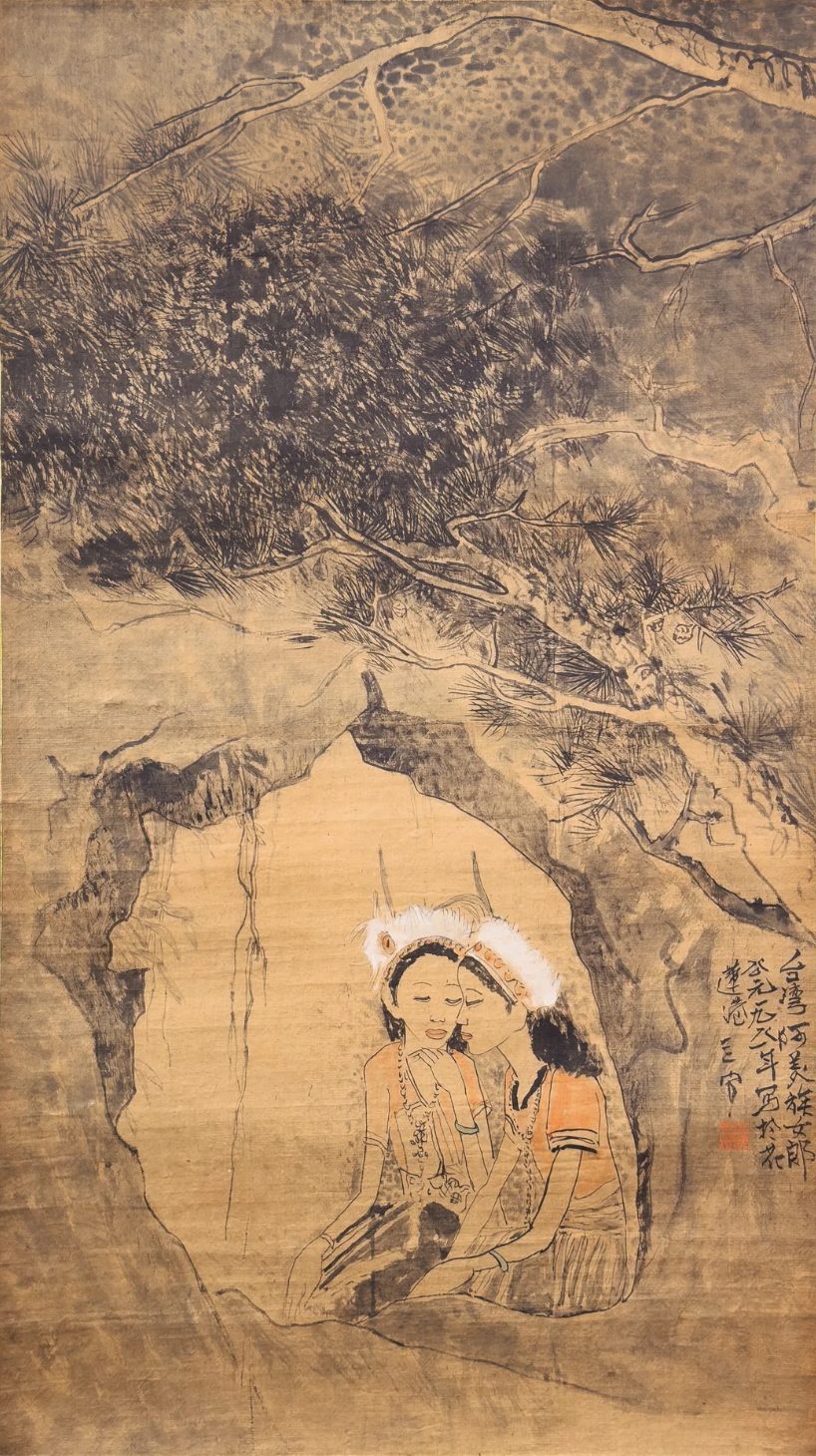
In Alishan Ladies, Cheong Soo Pieng made the relationship between human presence and landscape its organising principle. Two women sit closely together within a cave-like opening, surrounded by rock formations, trees and dense vegetation.
The vertical format emphasises the difference in scale between the small figures and the much larger landscape. The viewer's eye moves from the more open areas above towards the rocky formation that frames the women. The enclosing rocks distinguish the darker, irregular terrain from the lighter space occupied by the women, concentrating attention on the pair without separating them from their surroundings.
Branches and foliage cross the upper scene, linking the vegetation to the rock formation below. The contrast between the lighter interior and the darker surrounding forms establishes a visual balance between openness and density.
The rock mass is never shown in full: it extends beyond the left and right edges of the painted image, while the pine canopy is cropped by the upper border. Its extent is implied partly through the lighter, cave-like void occupied by the women rather than through a complete contour. By allowing the landscape to extend beyond the frame, Cheong suggests a world larger than the portion depicted. The cave-like opening, meanwhile, establishes an intimate space for the figures. The composition thus sets the landscape's apparent vastness against the women's sheltered position within it, lending them significance without allowing them to dominate the scene.
Cheong's approach invites comparison with the Southern Song painter Ma Yuan, whose asymmetrical arrangements and use of open space often create atmosphere. In Alishan Ladies, these principles are transformed rather than simply imitated: the interplay of open landscape, enclosing rock and carefully positioned figures becomes part of Cheong's distinctive Nanyang visual language.
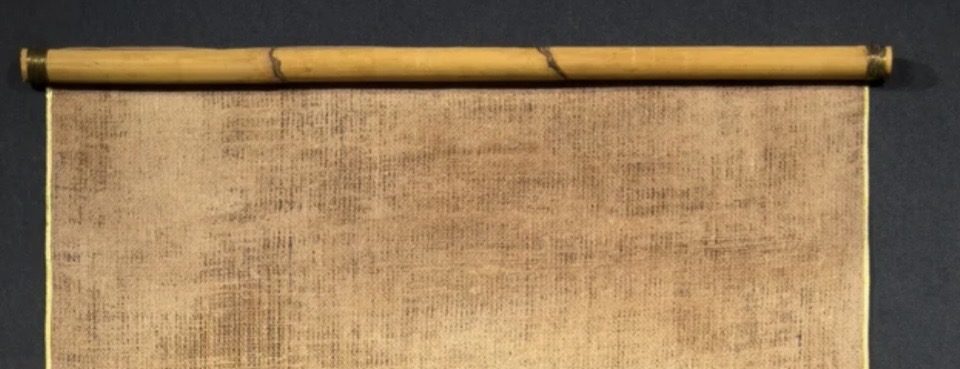
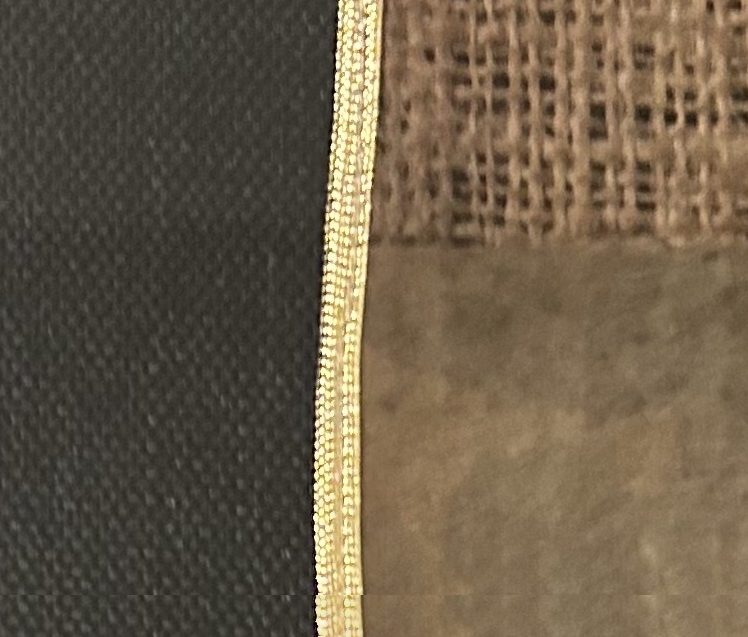
The scroll features rods (Fig. 3) attached to its top and bottom edges, with gold edging (Fig. 4) running along the other two sides. The rods anchor the scroll when unrolled, while the gold edging lends the presentation a decorative richness. This finish contrasts with the coarse, industrial character of the jute support. The juxtaposition of these materials forms part of the work's distinctive physical presentation and should be considered alongside Cheong's broader experimentation with unconventional supports and mounting.
The hanging-scroll format presents the complete composition at once, unlike the handscroll, which is typically unrolled progressively and encourages sequential viewing. The mounting establishes a physical boundary between the painted image and its surrounding materials. The work is thus encountered both as a landscape and as a material object, with its physical presentation forming part of the viewing experience.
Closeness and the Intimacy of the Female Figures
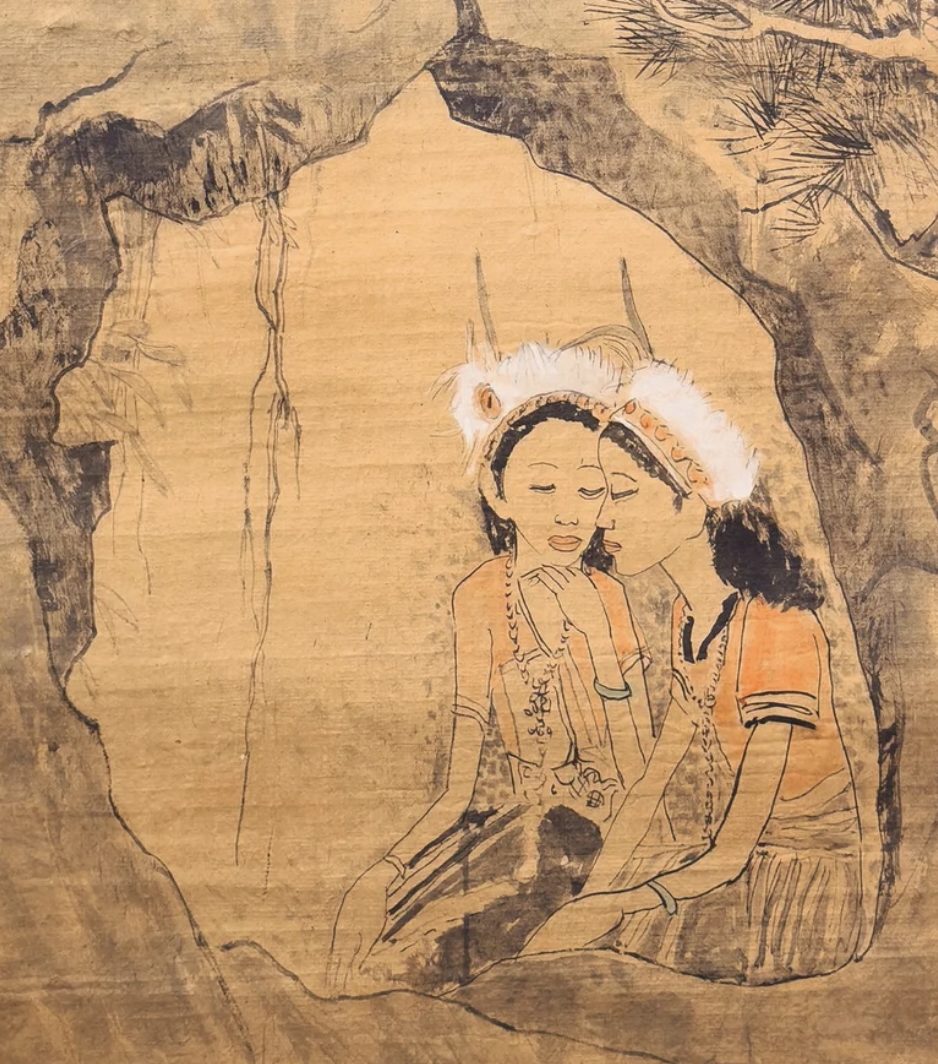
The physical closeness of the two women invites an interpretation centred on companionship and intimacy. The gentle turning of one figure towards the other suggests a quiet interaction rather than an overtly dramatic exchange. Within this secluded setting, their proximity conveys familiarity: the painting concerns not simply the representation of two women, but the experience of being together. Their costumes, headdresses and accessories deepen this impression. Both women wear ornamented headdresses, jewellery and patterned garments that distinguish them from generic figures. Their similar yet individually distinctive adornment suggests a shared cultural world, establishing visual kinship without erasing their individuality.
This attention to dress and adornment is consistent with Cheong's wider practice. His depictions of Southeast Asian women use traditional clothing and headwear to situate figures within regional contexts. Low (2010), for example, notes that the woman's Southeast Asian setting in Untitled (Girl with Birdcage) is suggested through her dress and headwear. Discussions of Cheong's later works also identify sarongs as significant features in his representations of local communities.
These details help present the women in Alishan Ladies as culturally situated individuals, while their elaborate adornment contrasts with the simplicity of their interaction. Their relationship nevertheless remains ambiguous. The painting offers no specific narrative; the women might be friends, relatives or simply two people sharing a moment of repose. Rather than resolving their relationship into a specific narrative, Cheong leaves its meaning open, allowing the women's gestures, proximity and adornment to sustain a sense of shared presence.
Technical Analysis
At first glance, Alishan Ladies appears deceptively simple, but Figure 5 reveals Cheong's controlled use of the brush. Economical, assured lines establish the figures' elongated forms, clothing and posture, while lighter ink washes give the bodies and surrounding landscape tonal depth. Rather than describing every detail, Cheong lets the character of each brushstroke suggest form.
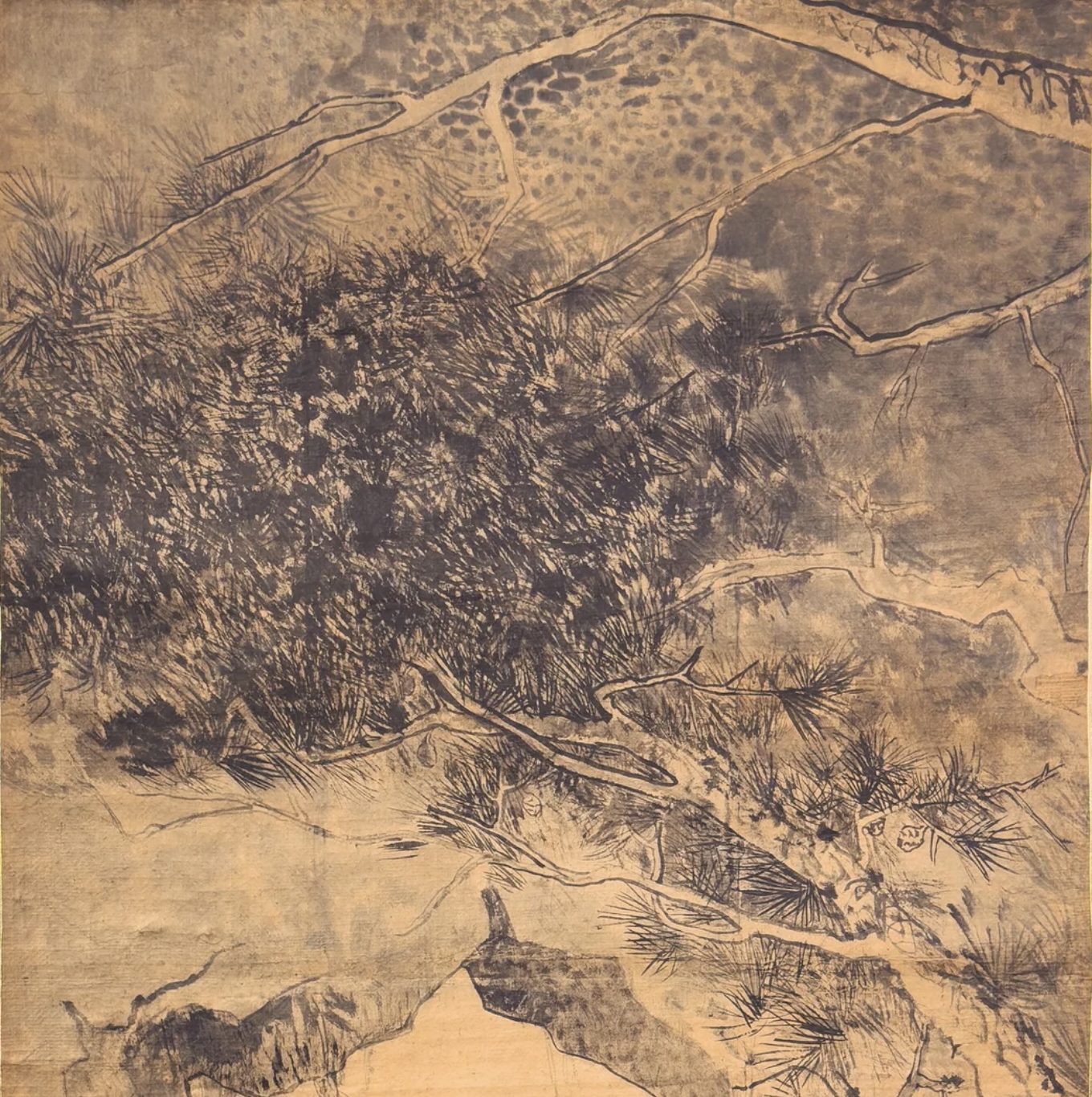
The figures are treated lyrically, in contrast to the more gestural upper landscape (Fig. 6). Balanced dark and light passages allow parts of the scene to emerge while others recede into softer washes, creating distance and atmosphere without conventional perspective. Firm contours and fluid washes establish the painting's visual rhythm. In the upper landscape, vigorous calligraphic contours, densely layered pine-needle strokes and variegated tonal washes over a warm ochre ground create energy and vitality. Dark pigment against exposed ground produces a weathered surface that evokes the rugged natural world.
The balance of precision and suggestion keeps the figures and landscape legible while allowing the brushwork and washes to sustain the scene's atmosphere. These qualities reflect Cheong's use of Chinese ink painting as a way of expressing an artistic identity rooted in the region where he lived and worked.
Closing Thoughts
Cheong Soo Pieng's Alishan Ladies exemplifies his late pursuit of a distinctive Nanyang artistic language. Executed on rice paper laid on jute and presented with rods and gold edging, it reinterprets the Chinese hanging scroll through materials associated with Southeast Asia. The work thus recontextualises a Sinitic pictorial convention within Nanyang material culture. Tan Yong Jun interprets Cheong's ink practice as an assertion of regional identity, while contemporary commentary has emphasised the Southeast Asian character of his Nanyang scrolls and his position as a traveller between cultures.
The painting's subject further complicates this cultural synthesis. By depicting women identified as Amis from Taiwan, it brings Chinese pictorial traditions, Southeast Asian material culture and Taiwanese Indigenous representation into a single encounter. This conjunction challenges any simple equation between artistic identity and geographical origin, suggesting that Nanyang art emerged through the negotiation of multiple cultural traditions.
Ho Sou Ping’s The Story of Cheong Soo Pieng (2nd ed., ArtCommune Gallery, 2023, p.294) records plans for exhibitions in several Chinese cities and identifies Sung-style Nanyang ink paintings among the works prepared for the proposed tour. The exhibitions did not take place following Cheong's death in 1983. The available evidence does not establish whether Alishan Ladies was intended for inclusion; nevertheless, its synthesis of Chinese pictorial convention and Southeast Asian materiality resonates with the broader artistic project described in the publication.
Ultimately, Alishan Ladies demonstrates how Cheong transformed inherited pictorial forms into a modern Nanyang idiom. His distinctive artistic identity emerged not through the rejection of tradition, but through its creative reconfiguration.
“Of course, I do not search for it consciously or create it deliberately. I doubt any artist does. But it is there. It is a way of bringing order and intelligence to what an artist is doing. It is a memory marker and also a means of connecting different ideas and emotions, fusing them into a creative force.”
— Cheong Soo Pieng
Quote found in ‘New styles from a turbulent era’, The Straits Times, 2 August 1983
Bibliography
- Ho Sou Ping, The Story of Cheong Soo Pieng (2nd ed., ArtCommune Gallery, 2023), p. 297 (item 287, Untitled) and p. 294 (planned exhibitions in China).
- ‘Cheong Soo Pieng: 4 Things to Know About the Singapore Pioneer Artist and His Ink Paintings’ (Tatler Asia, 2 June 2021), on Tan Yong Jun’s exhibition Tonalities: The Ink Works of Cheong Soo Pieng and Cheong’s Nanyang scrolls.
- Ma Yuan (comuseum.com), on the Southern Song painter’s asymmetrical compositions and use of open space.
- Diana Tay, ‘Building a Conservation Material Record: A Study of Paintings by Cheong Soo Pieng and Georgette Chen’ (thesis, University of Melbourne, 2022), on Cheong’s unconventional supports and mounting.
- Chinese Civilization: painting formats and techniques (University of Washington), on the hanging-scroll format.
- Low Sze Wee, ‘Cheong Soo Pieng – Art and Patronage’, BeMuse (National Heritage Board, October–December 2010), on dress and headwear as markers of regional setting.
- The Straits Times, interactive feature on Cheong Soo Pieng’s landscapes (2024), on sarongs in his later works.
- Men’s Folio: interview with curator Tan Yong Jun, on Cheong’s ink practice as an assertion of regional identity.
- ‘Art What!: Tonalities – The Ink Works of Cheong Soo Pieng’ (Bakchormeeboy, 28 May 2021), on the Southeast Asian character of the Nanyang scrolls.
- ‘New styles from a turbulent era’, The Straits Times, 2 August 1983, source of Cheong’s quoted statement.