Composition: A Lane Beside the Canal
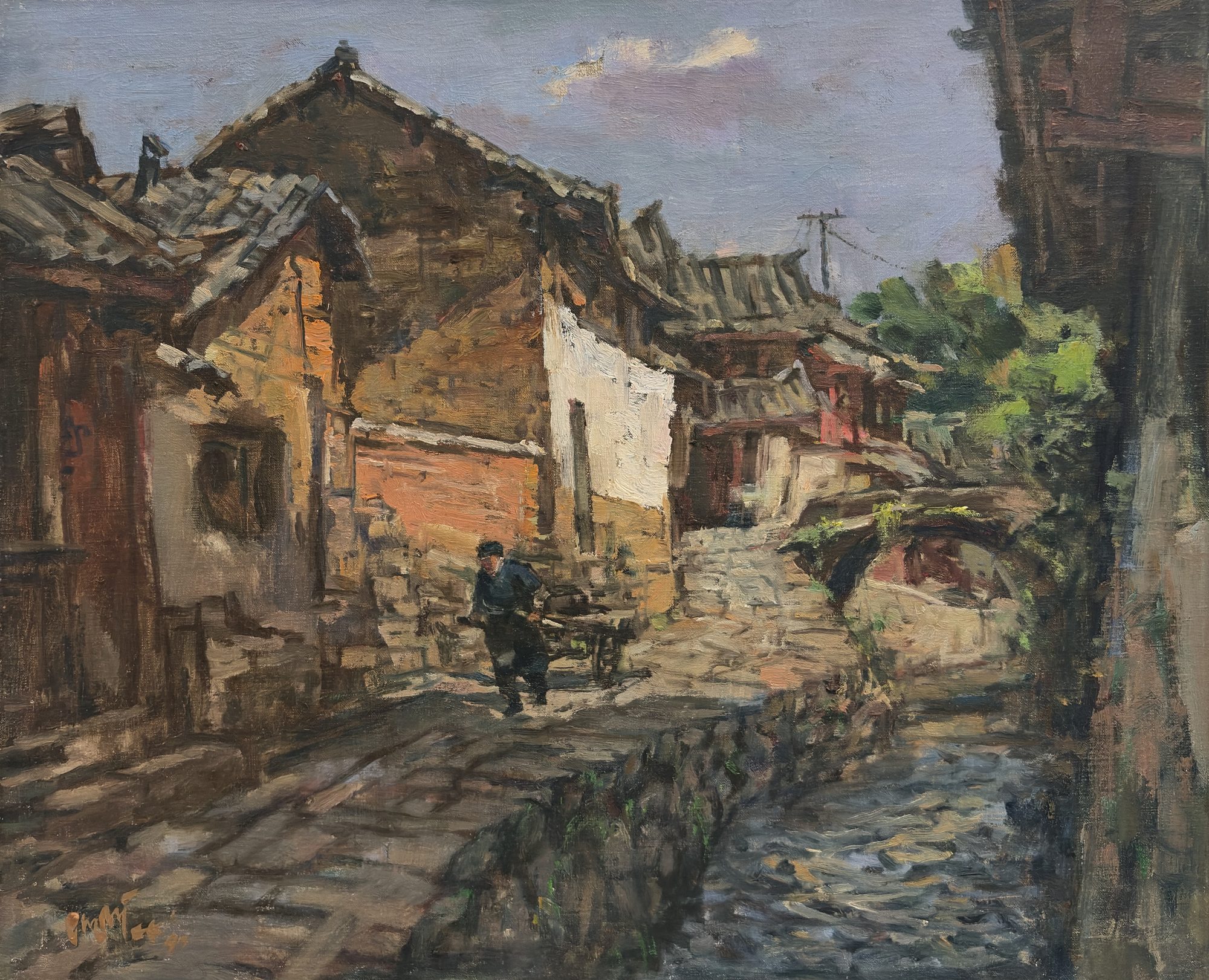
A paved lane runs from the lower left of the canvas to the middle distance, where it meets an arched stone bridge among greenery on the right. Houses with tiled roofs and stepped gables line the left side. A utility pole and its wires rise against the sky, and a dark building mass at the right edge acts as a frame, closing the scene and pushing the eye back toward the centre. In the foreground, a narrow stream of blue-grey water ripples at the lower right.
A man in dark clothes and a cap, leaning forward, pulls a wooden handcart along the lane. He is placed close to the centre of the canvas, and the whole composition is organised around him: the walls rise behind him, the paving leads to him, and the bridge beyond gives his movement a destination. His forward lean is the main source of movement in an otherwise still scene.
Colour Scheme
Of the four paintings in this group, this has the most saturated palette. The walls behind the figure are painted in brick orange and terracotta, with ochre in the lit planes and a single white gable wall that is the lightest passage on the canvas. Against this warmth, the sky is a violet-blue with a cloud in cream and pale yellow, and the stream in the foreground is blue-grey. The foliage at the right is a fresh yellow-green, the brightest and coolest-warm note in the picture.
The relationship between orange and blue is the key to the painting. Each is intensified by the other: the orange wall looks hotter against the violet sky, and the blue water looks cooler against the warm paving. The dark shadow areas, mixed from brown and green, hold the two together.
Look at the white gable wall to the right of the figure. It is not pure white: strokes of cream, grey and blue-grey are laid over one another, and a few dark marks suggest the stains and cracks of old plaster.
Brushwork and Technique
The brickwork and the roofs are painted in short, firm strokes that follow the direction of the surface they describe, while the paving is rendered with flatter, broader touches that follow the perspective of the lane. The painter does not draw the individual stones; he suggests them by alternating strokes of light and dark. The stream is handled differently again, in rippled, comma-shaped strokes of blue and grey that move across the lower right of the canvas.
Variation of touch of this kind lets each material in the scene have its own character without any change in the overall handling, and it keeps the surface lively across the whole canvas.
The Figure and the Handcart
The figure is the human centre of the work. He is painted in a few dark strokes with a lighter touch at the face and cap, and the wooden handcart behind him is little more than a set of dark verticals and a horizontal. Nothing in the picture explains his journey, yet his posture and the weight of the cart are convincing, and they add a note of labour to a scene that might otherwise have been purely picturesque.
Signature and Date
The painting is signed in the lower left in orange-ochre paint, followed by a small date that appears to read '97 and should be confirmed against the original. The warm colour of the signature suits the warm tones of the lane in which it sits.
Interpretive Assessment
China Street Scene is the warmest and most animated of the four works in this group. It joins a vivid, orange-and-blue palette with a clear narrative focus, and it shows that Tan Choh Tee could treat a traditional town not only as a subject for atmosphere but also as a setting for everyday labour.
The catalogue details and context should be completed from reliable documentation. In particular, confirm the title, the town depicted, the date, the dimensions, provenance and any known exhibition history before treating this interpretation as a final collection record.
Object Information and References
Catalogue data
Artist: Tan Choh Tee [Add Chinese name]
Title: China Street Scene [Confirm whether this is the original title]
Year: 1997
Medium: Oil on canvas
Dimensions: 53.5 × 65 cm (height × width)
Location depicted: [Confirm]
Provenance: [Add documented ownership history]
Exhibition history: [Add, if documented]
Bibliography
[Add publications, archival records, artist statements and exhibition catalogues used in the research.]