Composition: Roofs Below a Wooded Hill
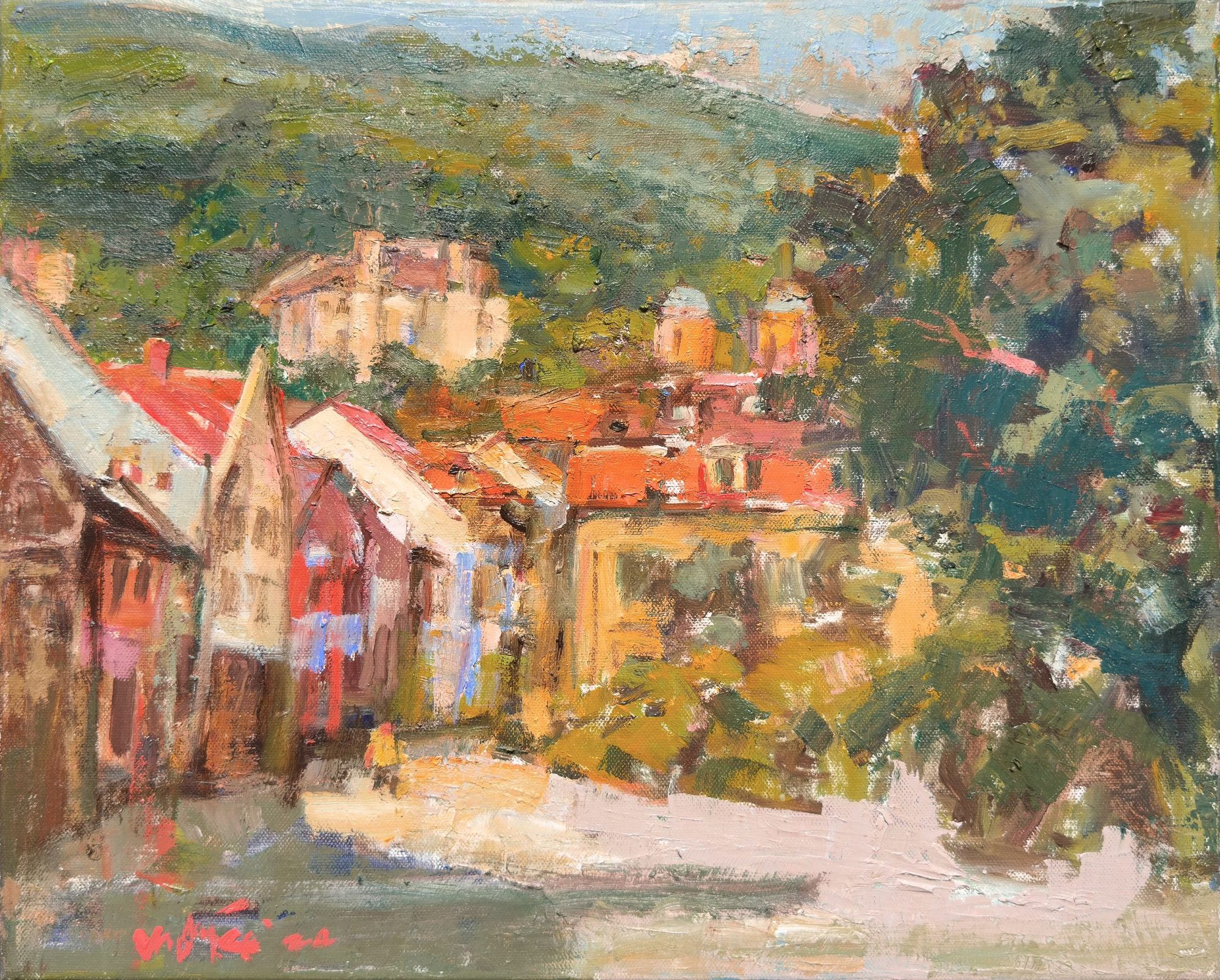
The picture is built in bands. A broad, sloping hill of olive and forest green fills the top third of the canvas, and a line of pale buildings with two yellow domed turrets stands against it near the centre. Below them, a cluster of orange and red tiled roofs steps down toward the left, where a cream gabled house and a brown wall form the nearest forms. A mass of dark trees on the right balances the buildings and closes the scene.
A small figure in yellow stands on the lit lane at the lower centre. It is the only clear human presence, and its position, directly beneath the roofs and at the end of a band of bright paving, gives the viewer a point of entry into the picture.
Colour Scheme
This is the most golden of the four paintings. The hill is painted in olive, bottle green and blue-green, and against it the roofs glow in vermilion and apricot, the walls in cream and ochre, and the sunlit lane in a pale gold. The turrets are the warmest notes in the upper half and are picked out in saturated yellow.
Cooler accents keep the warmth from becoming heavy. Strokes of cornflower and violet blue in the lower left, which may suggest laundry or shaded windows, answer the orange roofs across the picture, and the sky at the top right is a clear pale blue. The dark teal of the trees at the right gives the painting its deepest shadow.
Look at the pale building on the hill, just left of the centre. Its walls are made from cream, peach and pale grey laid over one another, and a few dark marks at the windows are enough to make it read as a large house at a distance.
Brushwork and Technique
The hill is painted in broad, horizontal drags of green that follow its slope, with the canvas weave visible in places. The roofs are made from short, firm strokes of orange and red set side by side, and the buildings are simplified into blocks of light and shadow. The trees at the right are handled differently again, in angular, overlapping touches of green, teal and yellow that give the foliage a broken, flickering surface.
Variation of touch of this kind lets each element have its own character without any change in the overall handling, and it keeps the large masses of hill and foliage from becoming monotonous.
The Hill and the Town
The relationship between the hill and the town is the subject of the picture. The hill is rendered in a few large planes, and the buildings on it are suggested rather than described, while the roofs in the middle ground carry most of the colour and the detail. The small figure in yellow ties the two levels together by placing a human scale at the foot of the slope.
Signature and Date
The painting is signed in the lower left in coral-red paint, followed by a small date that appears to read '24 and should be confirmed against the original. The coral of the signature is close to the red of the roofs above it, and it sits against the cooler green-grey of the foreground.
Interpretive Assessment
Miltenberg is the most open and sunlit of the four German townscapes. It combines a large, simplified landscape setting with a densely painted cluster of roofs, and it shows Tan Choh Tee moving easily between the scale of the hillside and the scale of the street.
The catalogue details and context should be completed from reliable documentation. In particular, confirm the title, the exact street and viewpoint depicted, the date, the dimensions, provenance and any known exhibition history before treating this interpretation as a final collection record.
Object Information and References
Catalogue data
Artist: Tan Choh Tee [Add Chinese name]
Title: Miltenberg [Confirm whether this is the original title]
Year: 2024
Medium: Oil on canvas
Dimensions: 40 × 50 cm (height × width)
Location depicted: Miltenberg, Germany [Confirm exact street and viewpoint]
Provenance: [Add documented ownership history]
Exhibition history: [Add, if documented]
Bibliography
[Add publications, archival records, artist statements and exhibition catalogues used in the research.]