Composition: A Terrace Between Timber Frames
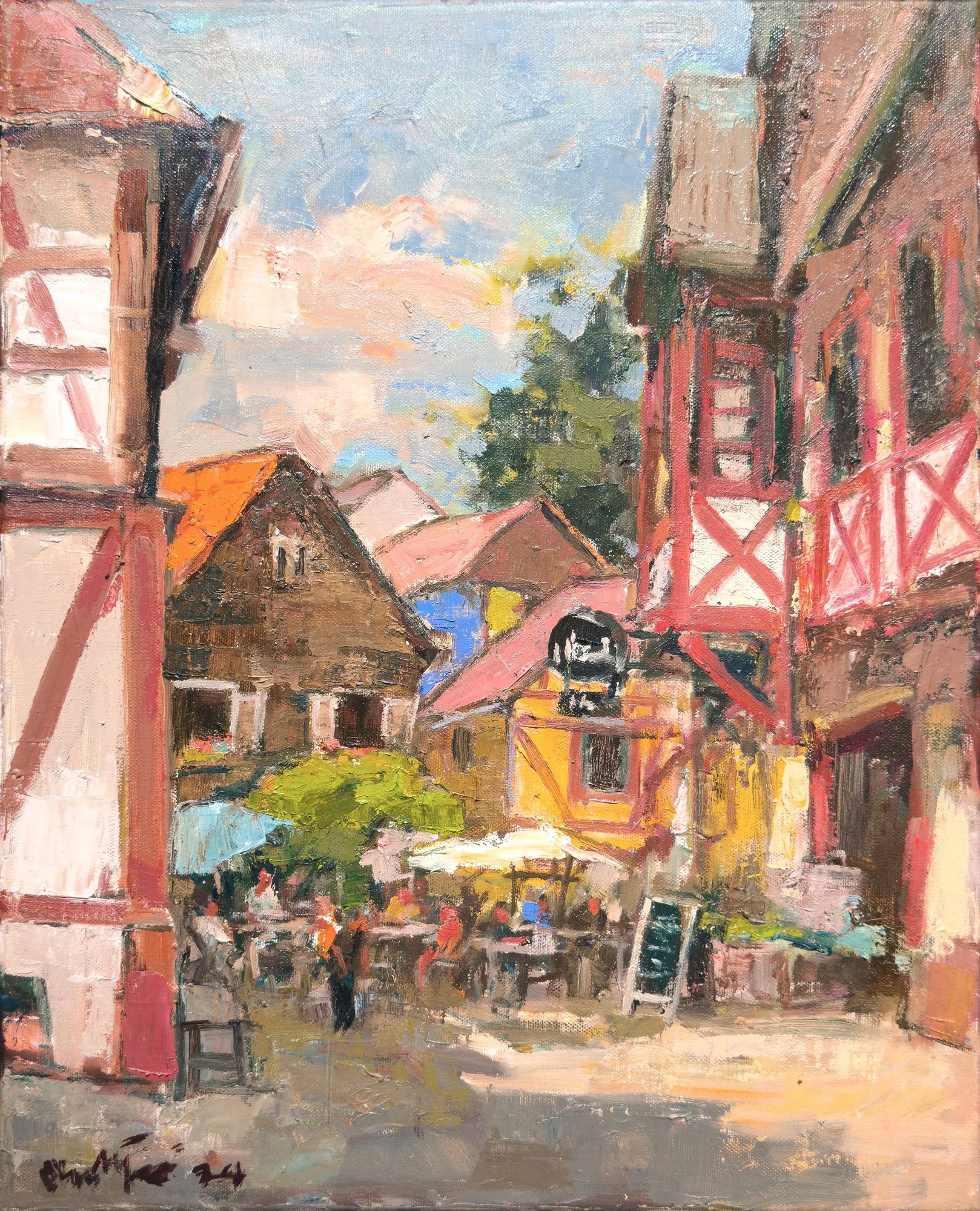
Tall half-timbered buildings fill the left and right edges of the canvas, their rose-red beams and white plaster forming two vertical frames. Between them the space opens to a small square. A brown gabled house with an orange roof stands at the left of the centre, a yellow house with a pink roof and a round black hanging sign at the right of it, and a dark green tree and a patch of blue wall show behind them.
In the lower third a terrace is set out under parasols in green, pale blue and cream. Small figures sit and stand among the tables, and a chalkboard leans against the wall at the right. The terrace is the brightest and busiest part of the picture, and everything above it, the beams, the roofs and the sky, is arranged to lead the eye down to it.
Colour Scheme
The palette is dominated by rose red and cream. The timber framing is painted in a strong, slightly cool red that is repeated in the pink of the roofs, while the plaster between the beams is cream and pale pink. The yellow house is the warmest passage and holds the centre of the canvas, with an orange roof at the left as its counterpart.
The sky is a clear blue with pink-tinged clouds, and a small patch of saturated blue wall behind the roofs answers it from within the town. The green parasol and the dark tree are the main cool notes, and they keep the reds from overwhelming the picture. The foreground is a warm, sunlit sand colour broken by a diagonal band of shadow.
Look at the black hanging sign above the yellow house. It is a round, nearly black shape with a few white strokes, and in a picture of reds and creams it is the strongest dark accent, a small point that fixes the centre of the composition.
Brushwork and Technique
The timber framing is drawn with a loaded brush in confident, slightly tilted lines, so that the red beams are both structure and pattern. The plaster between them is laid in with flatter, creamier strokes. The parasols and the figures are treated much more loosely, in quick dabs of colour that suggest people and tables without describing them, and the thicker paint on the roofs and beams stands out from the thinner, scrubbed passages of sky.
Variation of touch of this kind lets each part of the scene have its own character without any change in the overall handling, and it separates the firm architecture from the movement of the people beneath it.
The Terrace and Its Figures
The people on the terrace are painted in a few quick strokes, with touches of orange, red and blue for clothing and a dark standing figure at the left of the centre. They are not individuals but a general impression of a sociable afternoon, and they give the architecture its purpose. The chalkboard at the right is a small, precisely placed detail that suggests a place of business without any legible lettering.
Signature and Date
The painting is signed in the lower left in dark brown, almost black, paint, followed by a small date that appears to read '24 and should be confirmed against the original. The dark signature is close in tone to the hanging sign and the shadowed doorways, and it anchors the lower left corner of the canvas.
Interpretive Assessment
This is the most vertical and the most architectural of the four German townscapes. It uses the regular pattern of half-timbering as a structure for the composition and sets against it the looser, livelier forms of a café terrace, and it shows the painter combining a clear pictorial design with an easy, spontaneous touch.
The catalogue details and context should be completed from reliable documentation. In particular, confirm the title, the exact street and viewpoint depicted, the date, the dimensions, provenance and any known exhibition history before treating this interpretation as a final collection record.
Object Information and References
Catalogue data
Artist: Tan Choh Tee [Add Chinese name]
Title: Michelstädter Rathausbräu & Träumerei Café [Confirm whether this is the original title]
Year: 2024
Medium: Oil on canvas
Dimensions: 50 × 40 cm (height × width)
Location depicted: Michelstadt, Germany [Confirm exact street and viewpoint]
Provenance: [Add documented ownership history]
Exhibition history: [Add, if documented]
Bibliography
[Add publications, archival records, artist statements and exhibition catalogues used in the research.]