Composition: A Bridge Seen from the River
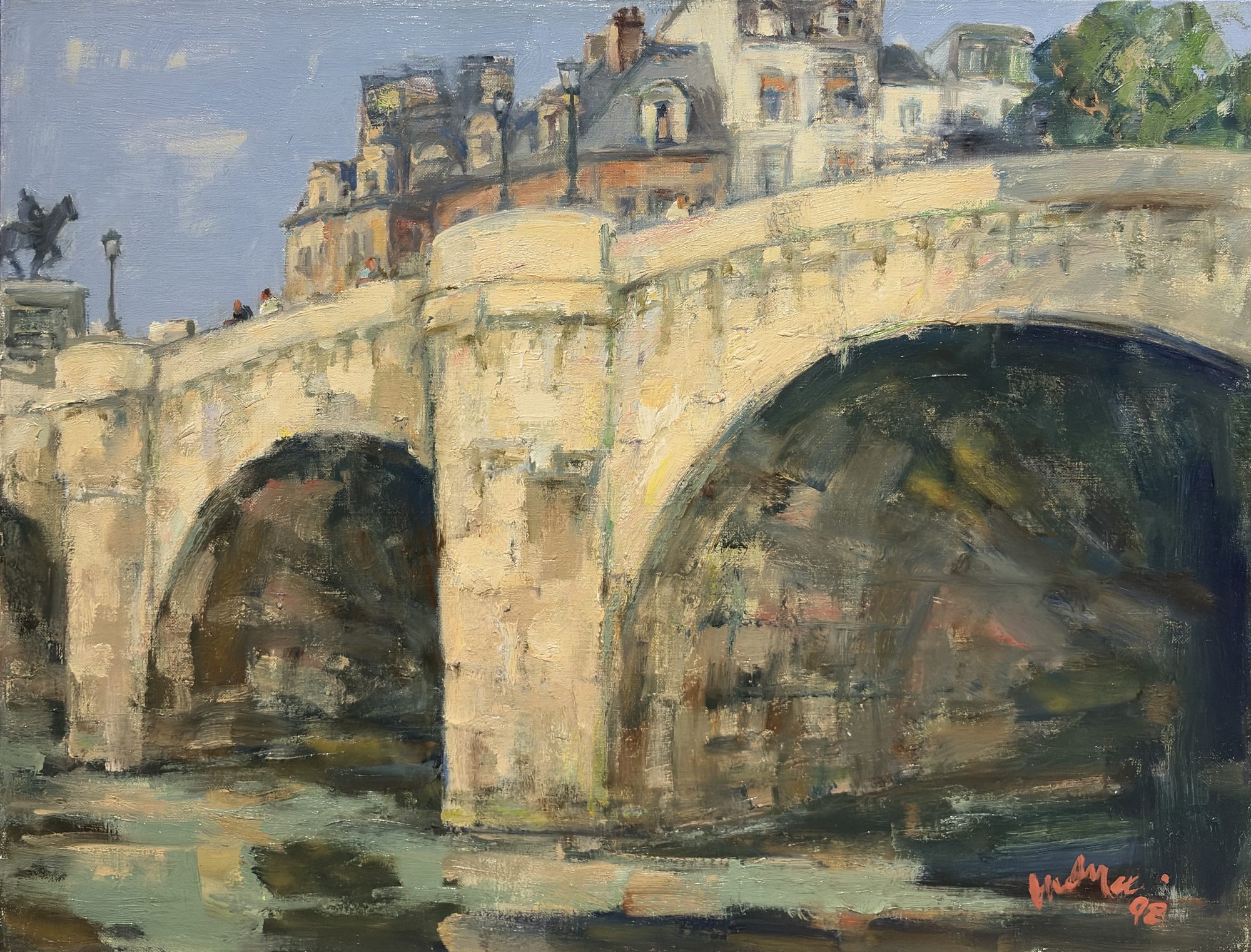
The bridge fills most of the canvas. Its pale stone body runs across the picture from left to right, and two dark arches open beneath it, a smaller one at the left of the centre and a much larger one at the right, divided by a thick, rounded pier that stands in the centre of the composition. The low viewpoint makes the stonework seem tall and heavy, and the arches read as deep, shadowed spaces.
Above the parapet, a row of buildings with grey, slate-coloured roofs and tall chimneys rises against the sky, with two lamp posts in front of them. At the far left an equestrian statue stands in dark silhouette on its base, and a few tiny figures walk along the bridge. A mass of green trees closes the upper right corner, while the lower third of the canvas is given to the river, which carries the reflections of the arches.
Colour Scheme
The palette is restrained and cool. The stone is painted in cream, buff and pale yellow, with touches of pink, lilac and grey where the light changes, and it is the lightest and warmest passage in the picture. Against it the arches are a deep blue-black mixed with green and brown, and the sky is a slate blue that grows paler toward the horizon.
The river is painted in sage and grey-green, with darker bands of blue-green and brown where the arches are reflected. The red-orange of the signature is the strongest warm accent in the picture, and a few small notes of orange and pink on the buildings and the figures above echo it at a distance.
Look at the face of the large pier at the centre. It is not a flat cream: strokes of buff, pale yellow, grey-green and lilac are laid over one another, and thin vertical marks of green suggest damp, moss and the seams between the stones.
Brushwork and Technique
The stone is painted with thick, dry strokes that catch the weave of the canvas, so that the surface of the bridge has a granular, weathered look without any individual blocks being drawn. The arches are handled differently, in thinner, darker, blended passages in which warm browns and greens show through the blue-black. The buildings above are suggested with a few firm strokes of grey, brown and cream, and the lamp posts and the statue are single, simplified dark forms.
Variation of touch of this kind lets each material in the scene have its own character without any change in the overall handling, and it sets the solid, sunlit stone against the deep, soft shadow below it.
The Arches and the Water
The arches are the dramatic centre of the picture. Their dark interiors are not empty but contain reflected light, faint reds and yellows and a suggestion of the water beneath, and this keeps the shadow alive. The river in the foreground repeats the shapes of the arches in broken, horizontal strokes, so that the bridge appears to stand on its own reflection.
Signature and Date
The painting is signed in the lower right in coral-red paint, followed by a small date that appears to read '98 and should be confirmed against the original. The coral is the warmest colour in the lower half of the canvas, and it stands out against the dark water and the shadow of the large arch.
Interpretive Assessment
River Seine, Paris is a study in the weight and light of stone. It shows Tan Choh Tee taking a European subject, familiar from the history of landscape painting, and treating it with the same loaded brush and simplified masses that he uses for his street scenes, but in a cooler and more monumental key.
The catalogue details and context should be completed from reliable documentation. In particular, confirm the title, the exact street and viewpoint depicted, the date, the dimensions, provenance and any known exhibition history before treating this interpretation as a final collection record.
Object Information and References
Catalogue data
Artist: Tan Choh Tee [Add Chinese name]
Title: River Seine, Paris [Confirm whether this is the original title]
Year: 1998
Medium: Oil on canvas
Dimensions: 50 × 65 cm (height × width)
Location depicted: River Seine, Paris, France [Confirm exact street and viewpoint]
Provenance: [Add documented ownership history]
Exhibition history: [Add, if documented]
Bibliography
[Add publications, archival records, artist statements and exhibition catalogues used in the research.]