Composition: Towers Above the Old Roofs
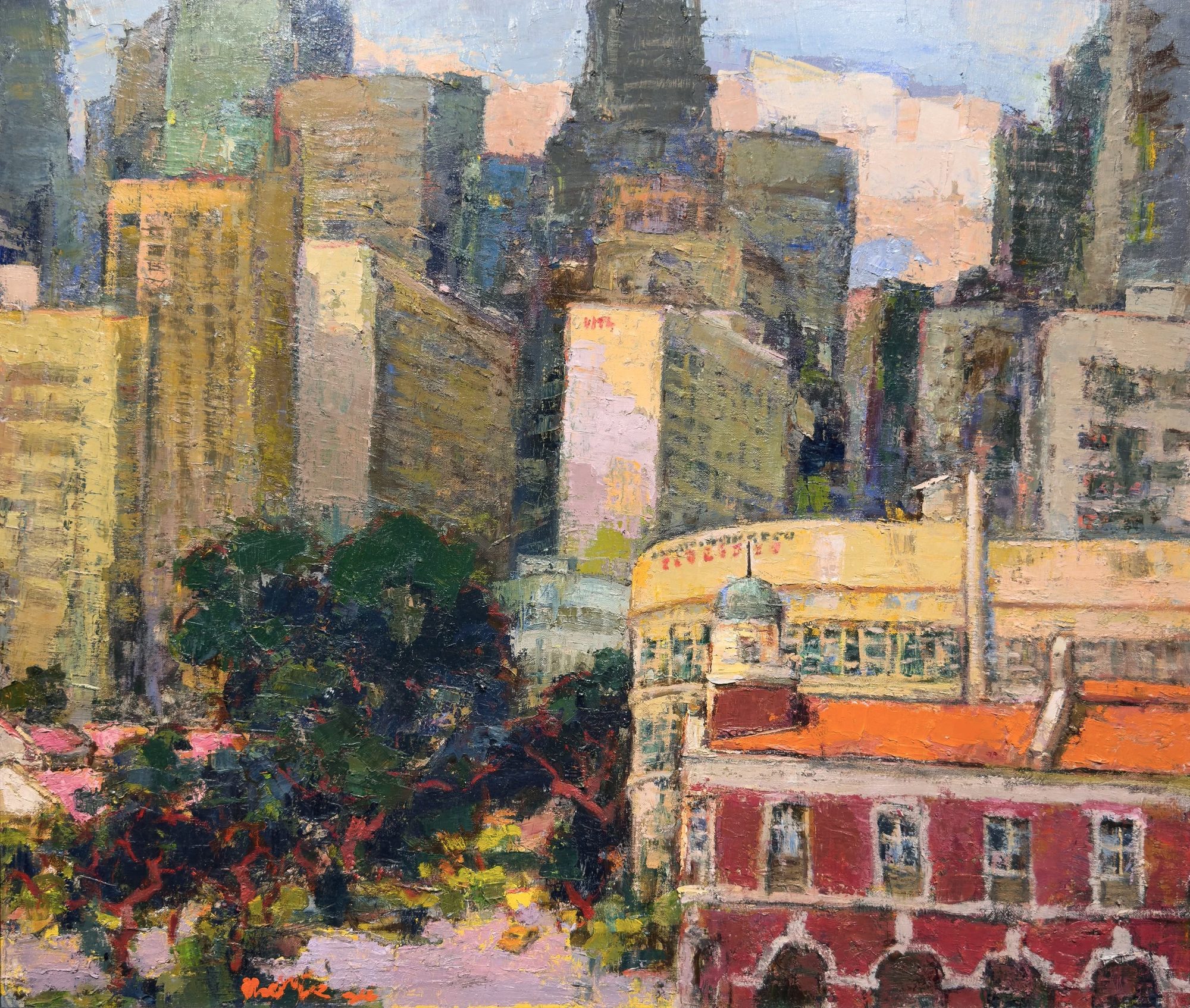
The canvas is divided into two zones. The upper two-thirds are filled with a crowd of tall towers, some pale yellow and cream, others olive, grey and dark green, which rise to the top edge and almost close off the sky. A darker tower at the top centre forms the highest point and the vertical axis of the picture. The lower third is given to older, low buildings and trees, which set the human scale against the height behind them.
At the lower right a yellow curved building with a small green dome stands above a brick-red building whose bright orange roof is the strongest accent in the picture. At the lower left a mass of dark trees with red branches fills the corner, with touches of pink at the edge that may be awnings or stalls. A lilac street runs along the bottom and links the two sides.
Colour Scheme
The palette is at once warm and subdued. The towers are painted in butter yellow, ochre, olive, sage and grey-green, so that the whole upper area has a hazy, sunlit tone. The sky shows through in small areas of peach, cream and slate blue, and the peach reappears in the lit faces of the towers and in a pink-lilac wall at the centre.
The lower right is the most saturated part of the canvas. The orange roof, the brick red of the wall below it and the cream of the curved building are set against the deep greens of the trees on the left, and the red-orange of the signature repeats the colour of the roof. The red branches among the trees tie the left and right sides together.
Look at the pale tower at the centre, with a few red letters near the top. Its wall is laid in with cream, pink and lilac, and the shaded side beside it is an olive green, so that two simple planes are enough to describe a building rising out of the haze.
Brushwork and Technique
The paint is thick and the surface is heavily worked. The towers are built from vertical drags of colour that follow the height of each building, with the dry paint catching the weave of the canvas, and the windows are suggested by small, broken touches of dark and light rather than drawn. The trees are handled in short, dense strokes of green and blue with sharp red lines for the branches, and the orange roof is laid in with a few flat, confident strokes.
Variation of touch of this kind lets each element have its own character without any change in the overall handling, and it keeps the large number of towers from becoming repetitive.
The Old Buildings and the Trees
The low buildings and trees are the human centre of the picture. The curved building with its dome and the red wall with its arched openings at the bottom edge belong to an older city, and they are painted with more detail and more saturated colour than the towers behind. The trees add a darker, cooler note, and they separate the old buildings from the new ones without any hard boundary.
Signature and Date
The painting is signed in the lower left in orange-red paint, followed by a small date that appears to read '24 and should be confirmed against the original. The colour of the signature is close to the orange of the roof in the opposite corner, and it sits against the lilac of the street.
Interpretive Assessment
View of Tanjong Pagar, Singapore is the densest and most vertical of the recent townscapes. It sets a crowd of modern towers against a few older buildings, and it shows Tan Choh Tee treating a skyline as a matter of colour and texture, with the old roofs and trees as the points of warmth and depth.
The catalogue details and context should be completed from reliable documentation. In particular, confirm the title, the exact street and viewpoint depicted, the date, the dimensions, provenance and any known exhibition history before treating this interpretation as a final collection record.
Object Information and References
Catalogue data
Artist: Tan Choh Tee [Add Chinese name]
Title: View of Tanjong Pagar, Singapore [Confirm whether this is the original title]
Year: 2024
Medium: Oil on canvas
Dimensions: 68 × 80 cm (height × width)
Location depicted: Tanjong Pagar, Singapore [Confirm exact street and viewpoint]
Provenance: [Add documented ownership history]
Exhibition history: [Add, if documented]
Bibliography
[Add publications, archival records, artist statements and exhibition catalogues used in the research.]