Composition: A Lane Closed by a Sunlit Wall
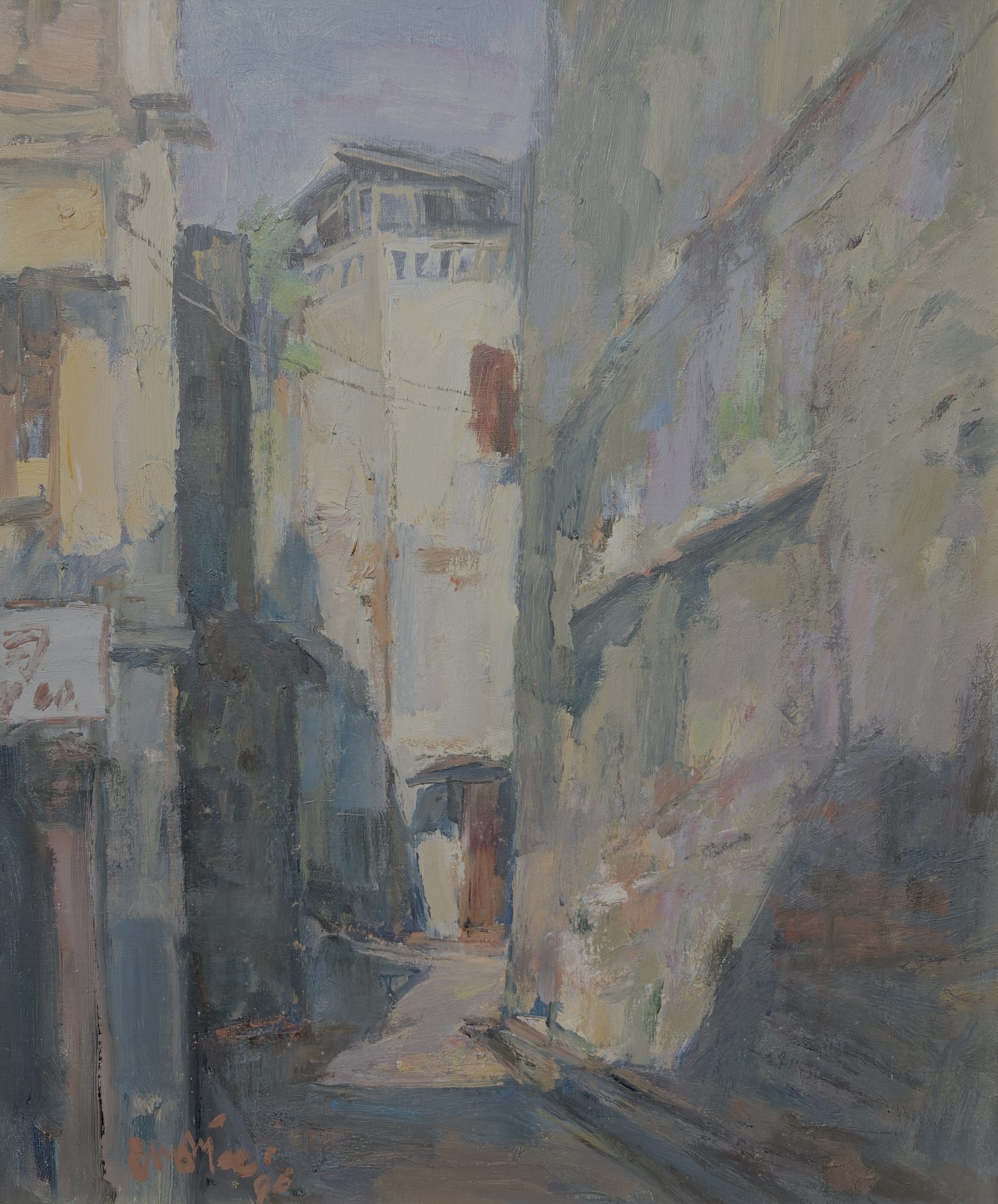
The alley is a narrow, steep corridor between two masses. At the left, a yellow-ochre building with a signboard stands above a nearly black wall of shadow, and at the right a huge olive-grey wall slopes up and across the canvas in a strong diagonal. Between them, the lane climbs toward a cream building lit by the sun, with a rust-red shutter at the upper right and a red-brown door at its foot, and above it a small upper storey with a pavilion-like roof and rows of windows.
A pale path winds from the lower centre toward the door, and it is the only open ground in the picture. Overhead wires cross the lane from the left, and a little green foliage shows beside the sunlit building. The sky is a narrow slice of violet-blue at the top, and there are no figures, so the lane is empty and still.
Colour Scheme
The palette is dominated by deep, cool darks. Indigo, blue-black and dark teal fill the left and the foreground, and the large wall at the right is painted in olive, grey-green and dusty lilac, with touches of violet and rose where the light grazes it. These cool, broken tones make the lane feel enclosed and shaded.
Against this, the sunlit building at the centre is the lightest passage in the picture, painted in cream, butter yellow and pale peach, and it draws the eye straight down the lane. The rust-red of the shutter and the door, repeated in the signature, is the only strong warm accent, and small orange and rose touches along the path carry its warmth into the foreground.
Look at the large wall at the right. It is not one flat olive tone: green, grey, lilac, rose and blue are dragged over one another in long diagonal strokes, and a few touches of orange along the lower edge suggest sunlight reflected off the ground.
Brushwork and Technique
The paint is handled in broad, dragged strokes that follow the planes of the walls, and in many places it is thin enough to let the canvas weave show through. The shadowed areas are painted in dense, dark, blended passages, while the sunlit building is built up in thicker, creamier strokes that catch the light. The signboard, the shutter and the wires are single, economical marks, and the foliage is a small cluster of fresh green that stands out against the cool tones.
Variation of touch of this kind lets each surface have its own character without any change in the overall handling, and it keeps the large, simple masses of shadow from becoming flat.
The Lane and the Light
The lane itself is the subject. There are no people in it, but the signboard at the left, the wires overhead and the red door at the end suggest a place that is lived in and used every day. The path is painted in a few strokes of rose, peach and violet, and the strip of light across it makes the eye move along the lane and up to the lit building.
Signature and Date
The painting is signed in the lower left in rust-red paint, followed by a small date that appears to read '96 and should be confirmed against the original. The rust of the signature is close to the red of the door and the shutter, and it stands out against the dark blue-black of the lower left.
Interpretive Assessment
Chinatown Back Alley is one of the most compressed and dramatic of Tan Choh Tee's street scenes in the collection. It builds a whole picture out of a dark lane, a diagonal wall and a single lit building, and it shows how much he could achieve with a limited range of tones and a few precise accents of red.
The catalogue details and context should be completed from reliable documentation. In particular, confirm the title, the exact street and viewpoint depicted, the date, the dimensions, provenance and any known exhibition history before treating this interpretation as a final collection record.
Object Information and References
Catalogue data
Artist: Tan Choh Tee [Add Chinese name]
Title: Chinatown Back Alley [Confirm whether this is the original title]
Year: 1996
Medium: Oil on canvas
Dimensions: 65 × 53 cm (height × width)
Location depicted: Chinatown [Confirm city, street and alley]
Provenance: [Add documented ownership history]
Exhibition history: [Add, if documented]
Bibliography
[Add publications, archival records, artist statements and exhibition catalogues used in the research.]