Architecture, Hawker and Urban Space
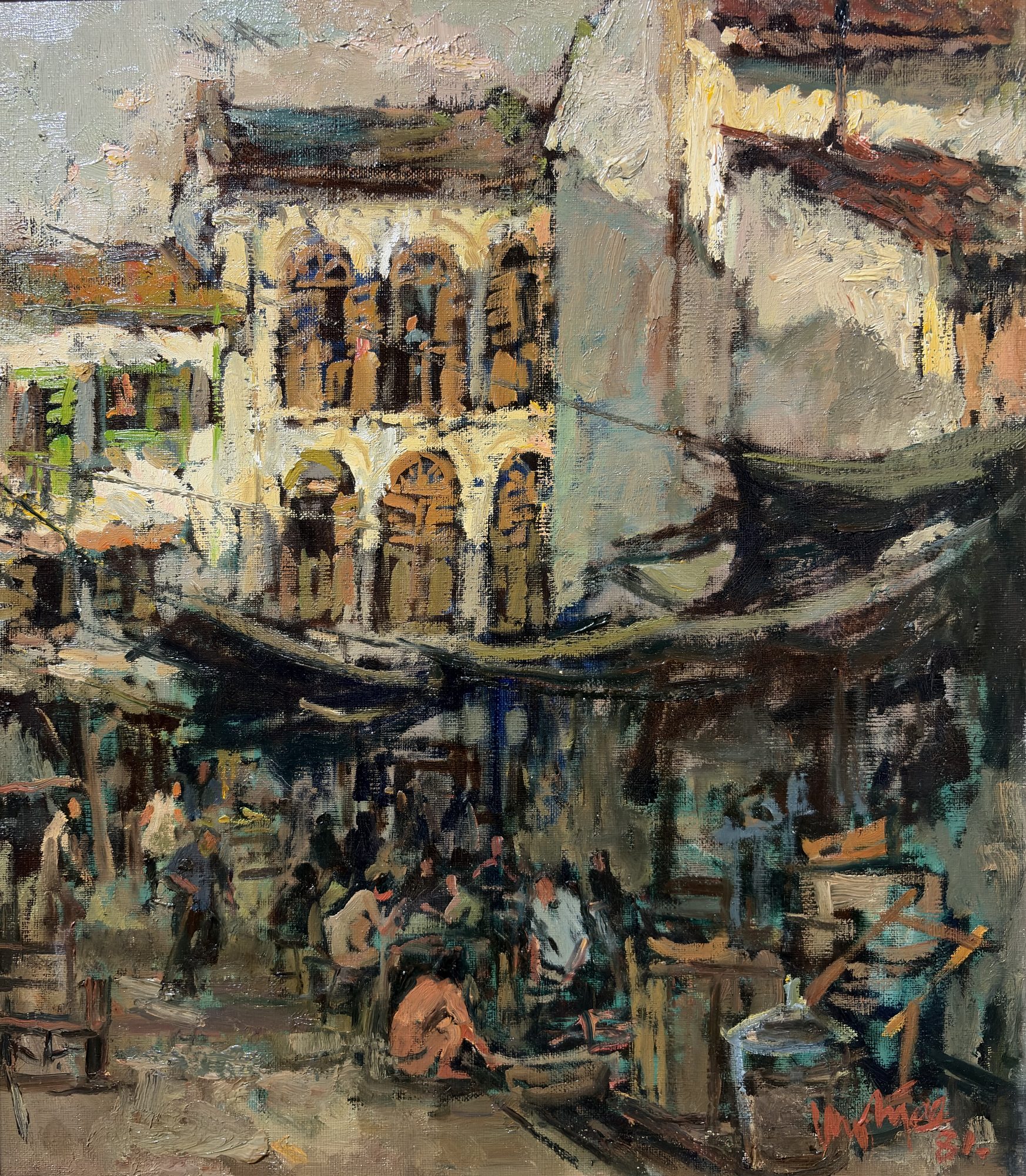
The composition brings together a closely observed streetscape and a lively hawker setting. A multi-storey building with repeated arched windows anchors the upper centre, while tiled roofs, weathered walls and projecting structures overlap around it. In the right foreground, a large awning creates a strong diagonal, partially obscuring the architecture behind it. Below, the hawker scene occupies a crowded space animated by people, benches and everyday activity.
The painting's spatial organisation depends on these contrasts: the relatively stable, well-lit architectural façade above; the awning spanning the middle ground, casting shadows across the scene; and the darker, more animated activity of the crowd below. The viewer's eye moves between these layers rather than settling on a single focal point.
Brushwork, Texture and Colour
The painted surface is animated by visible, energetic brushstrokes. Pale grey, cream and ochre passages describe the sunlit walls and upper façades, while deeper browns, charcoal and blue-green tones gather beneath the roofs, along the awning and among the crowd below. The paint is often applied in short, broken strokes, preserving the varied textures and vitality of the surface rather than rendering them in a uniformly smooth, naturalistic manner.
Warm terracotta accents punctuate the cooler greens and greys, recurring across roof tiles, clothing and objects throughout the street. These touches establish subtle chromatic links between otherwise distinct elements, lending cohesion to the scene without diminishing the variety of its palette. The interplay of these colours further reinforces the contrast between the lighter architectural planes and the deeper shadows below.
The roof tiles are built from single, angled strokes laid side by side, each one slightly different. The paint dries unevenly, and that inconsistency is what gives the upper architecture its weight — a flat wash would have collapsed the façade into a backdrop.
The Awning as a Compositional Counterweight
The broad awning dominates the right half of the composition. Its sweeping curved form cuts across the scene, mediating between the lighter architecture above and the crowded hawker activity below. This expansive shape acts as a counterweight to the upright façade and its repeated arches. More than a descriptive detail, the awning plays a structural role in organising the relationship between the upper and lower parts of the painting.
Dark outlines and layered green-black, brown and blue-grey strokes give the awning substantial visual weight. At the same time, the uneven edges and broken highlights keep its surface integrated with the painting's lively handling of paint.
The awning is not merely a structural feature; it is the painting's hinge — the form around which the upper architecture and lower hawker scene are brought together.
— Catalogue note
People and Everyday Activity
Small figures gather beneath the awning and along the street. Their forms are abbreviated, with touches of peach, rust, cream, blue and dark brown suggesting clothing, limbs and gestures without defining each individual in detail. Their diminutive scale establishes the proportions of the surrounding buildings and vessels, while their concentration animates the lower part of the composition, conveying the density and activity of everyday hawker life.
Rather than presenting an empty architectural study, the painting places built space within the rhythms of work and movement. The figures remain difficult to separate individually, yet collectively they give the setting its social character.
Interpretive Assessment
Alley can be read as a portrayal of urban life shaped by the interplay of architecture and human activity. Its expressive force arises from the contrast between the repeated arches of the windows, the sweeping mass of the awning and the densely worked, fragmented foreground. Visible brushwork keeps the scene from becoming a mere documentary record; the character of the place emerges instead through colour, texture and the artist’s selective emphasis.