The Shopfront and Spatial Organisation
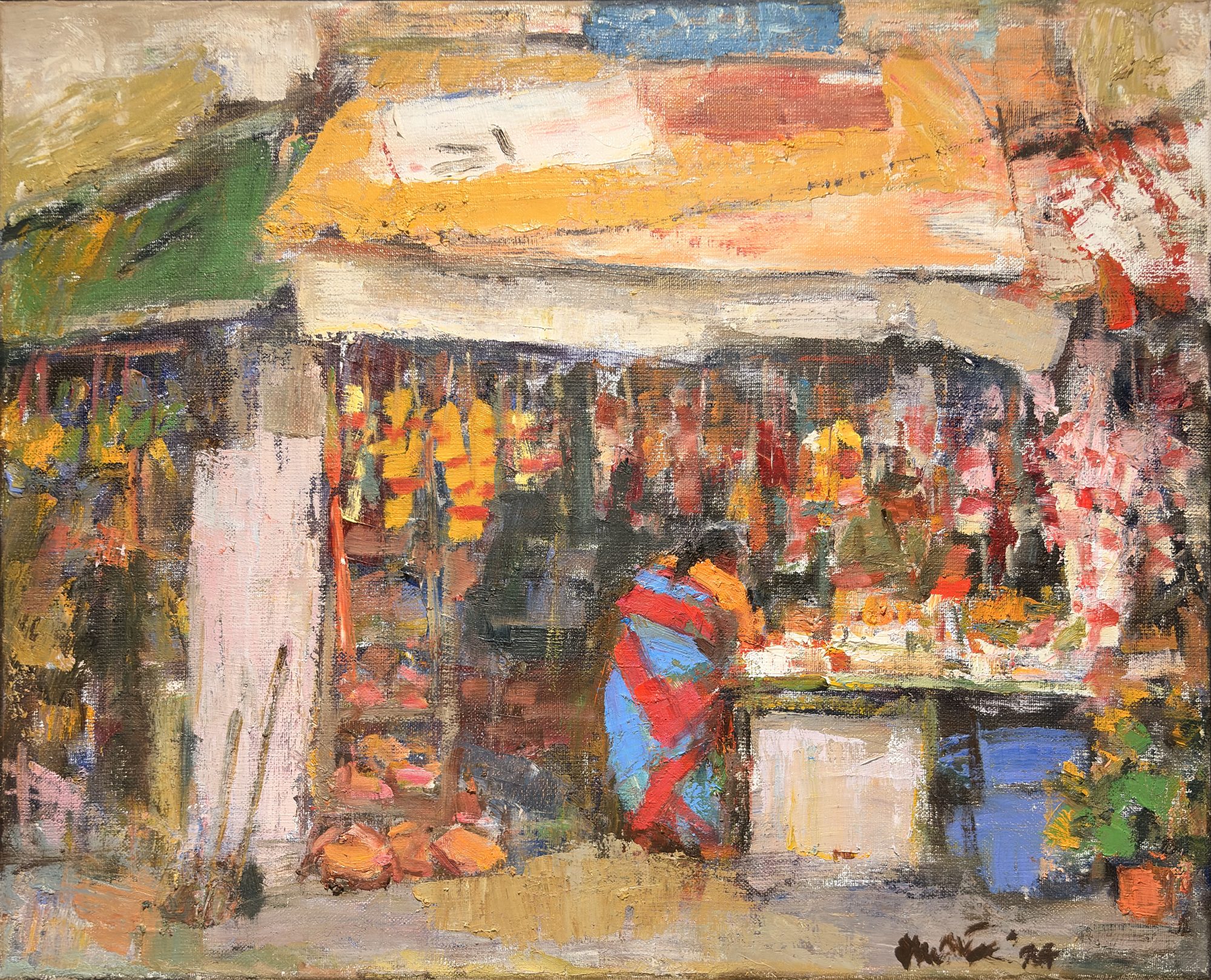
Shop in Little India presents a flower garland shop as a compact, visually abundant scene of everyday commerce. Rather than offering a sharply defined inventory of its contents, the painting conveys the experience of standing before a crowded shopfront. Garlands, merchandise, containers and architectural features press into one another, forming a richly varied field of colour and texture.
The composition is organised around the shop’s broad awning, which stretches across the upper middle of the canvas. Its pale underside forms a strong horizontal band, separating the brighter structures above from the darker, densely occupied shop interior. Above it, broad passages of yellow, orange, cream and muted blue suggest the sunlit surfaces of the awning and surrounding structures. At the left, a pale vertical post provides a firm visual boundary, while the counter and blue containers on the right establish another point of compositional weight. These horizontal and vertical elements give the scene an underlying structure, while the irregular arrangement of goods and flowers prevents it from becoming rigid.
The Garland Display: Colour and Abundance
The garlands provide much of the painting’s visual richness. Yellow and orange strands stand out near the centre-left, while red, pink and white groupings gather more prominently on the right. The repeated forms suggest abundance, while overlapping strokes and patches of colour convey the density of the display without defining each garland individually. The darker recesses behind them add depth, allowing the brighter flowers to emerge from the shadowed interior.
The contrast between the concentrated displays and the lighter awning and foreground heightens the impression of a shop filled almost to its edges. The flowers become more than individual items of merchandise; collectively, they form an important compositional and chromatic element, giving the shopfront much of its distinctive character.
Colour is not applied to the scene; it is the scene. Warm and cool passages converge across the awning, hanging garlands and shadowed interior, giving the shop its distinctive visual energy.
— Catalogue note
The Human Presence
A single figure stands near the centre, turned towards the counter and partly absorbed into the activity of the shop. The vivid blue and red of the clothing distinguish the figure from the surrounding merchandise, making the person an immediate point of attention. Yet the figure is not isolated as a portrait. The abbreviated features and energetic strokes integrate the body with the objects around it, suggesting a moment of work within the ordinary rhythm of the business.
The human presence gives the display scale and purpose: these flowers are not simply decorative forms, but goods arranged, handled and sold. The figure also introduces a point of human connection within an otherwise densely populated visual field of merchandise and colour.
Brushwork and Painterly Expression
Tan’s expressive handling of oil paint is central to this effect. Broad, broken strokes and areas of thickly worked pigment preserve the material liveliness of the surface. Colours are placed alongside one another rather than blended into uniformly smooth transitions; edges remain loose, and details emerge through contrasts of tone and mark. Warm ochres, oranges, reds and pinks animate the shopfront, while greens, blues, greys and dark browns provide counterpoints and visual depth.
Look closely at the lower-right corner: the paint is pulled almost dry across the canvas, leaving the weave exposed. It is a small gesture, but it keeps the surface from closing into a picture and reminds us that this is a made object.
This handling gives the painting a raw, energetic quality. It feels observed rather than polished, capturing the noise and movement of the market through the physicality of paint.
Everyday Commerce and the Character of Place
Shop in Little India is more than a depiction of a retail interior. Through its compressed space, abundant colour and vigorous brushwork, Tan Choh Tee captures the sensory character of a working flower shop and the everyday commerce that animates the neighbourhood. The familiar activity of arranging and selling garlands becomes an exploration of the visual richness of urban life. The shopfront, its merchandise and the human presence within it come together in an animated composition that conveys something of the distinctive atmosphere of Little India through the artist's direct and expressive interpretation.