A River Remembered: The Poetry of Place and Time
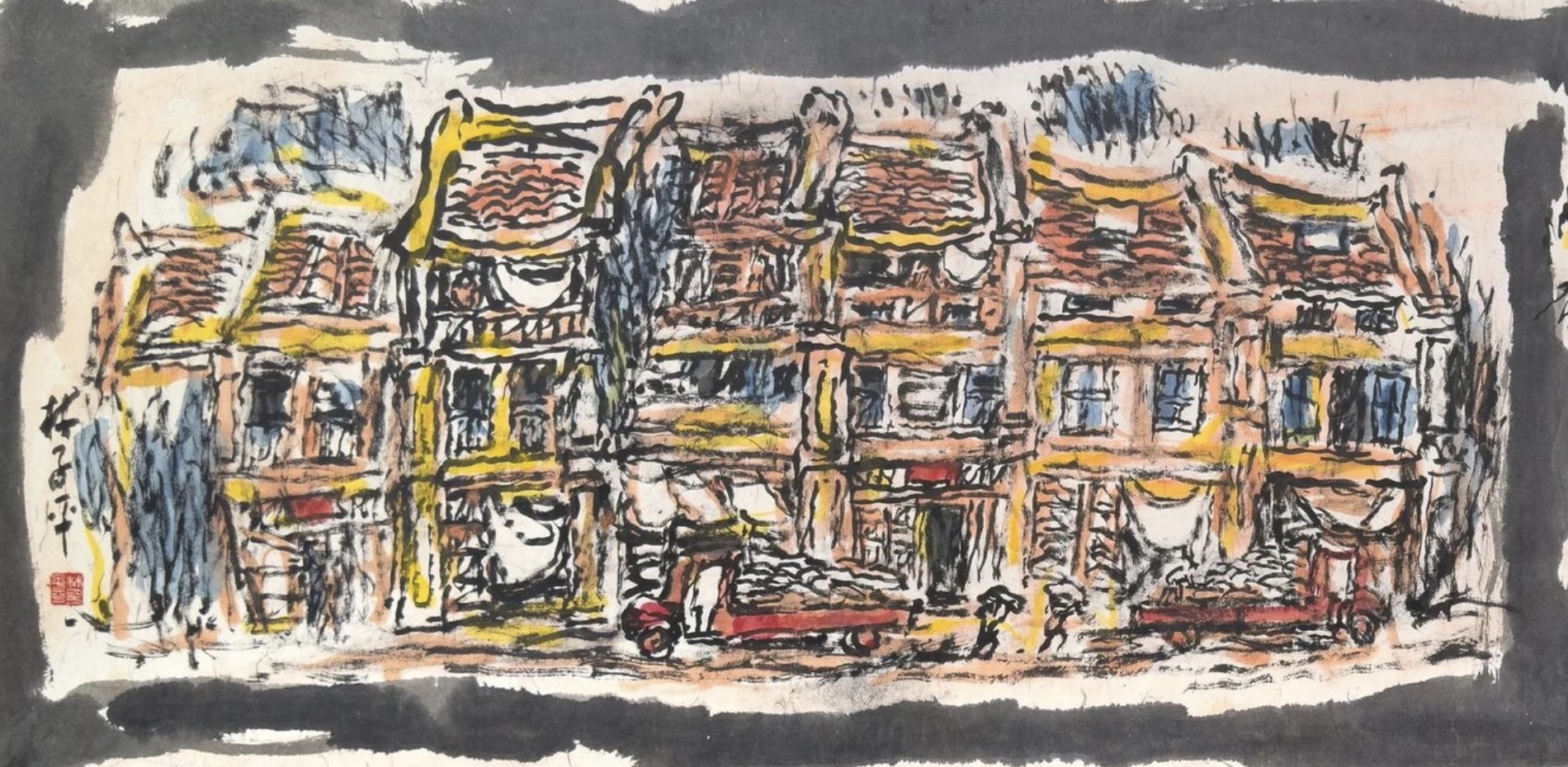
In Reminiscence of the River, Lim Tze Peng presents more than a familiar urban streetscape. He offers a personal recollection of a place, bringing together architecture, movement and atmosphere through the language of memory. Traditional shophouses dominate the composition, their tiled roofs, balconies and shopfronts evoking an older Singapore. At street level, vehicles and small human figures animate the scene, suggesting the everyday rhythm of a neighbourhood shaped by trade, activity and community.
The title invites us to consider the river as the point of departure for this recollection. Yet it is the surrounding buildings and street life that occupy the visual foreground. This contrast is intriguing: perhaps what endures is not necessarily the river itself, but the world that grew around it — its streets, buildings and familiar daily encounters. In this sense, the painting becomes a recollection not merely of a geographical setting, but of the life, atmosphere and associations that once gave it meaning.
The Architecture of Memory
The shophouses form the dominant structure of the composition. Their repeated façades establish a strong horizontal rhythm, while variations in rooflines, windows and architectural details give each building its own identity. The arrangement is recognisable, but not rigid. Buildings appear to shift and lean, and their proportions are not always governed by conventional perspective.
Lim Tze Peng does not paint the street as the eye once saw it, but as the mind has chosen to remember it.
— Catalogue note
This is particularly evident in the painting's subtly convex perspective. The streetscape seems to bulge towards the viewer, almost as though observed through a gently curved lens. Rooflines and façades bend, while the spatial relationships between buildings become fluid. The effect is not simply an unusual way of depicting architecture; it gives the composition a distinctly psychological quality.
Memory rarely preserves the exact proportions of a place. It retains impressions, enlarges certain details and allows others to fade. A familiar street may become more vivid in our minds than it ever appeared in reality. In this sense, the painting's distorted perspective can be read as an expression of recollection: the artist is not merely recording a physical setting, but reconstructing it as an inner landscape.
The Language of Ink and Colour
The broad bands of grey-black ink are among the work's most striking features. Running around the edges of the paper and cutting across it, they divide the composition into three panels: a row of shophouses, a corner building, and a stretch of river with boats. Their dry, ragged brushwork is left visibly raw, with broken textures and uneven edges, and the bands swell and thin with the movement of the hand. Each scene is set apart like a framed view, so the composition reads as a series of remembered moments rather than a single continuous landscape. Yet the framing is not entirely continuous, giving way at the lower-right edge. Is this interruption merely incidental, or does it allow the river to retain a sense of continuity beyond the otherwise enclosing framework? At the same time, the break introduces a measure of visual relief, tempering the weight of the broad ink bands and preventing them from overwhelming the composition.
Within these panels, the architectural drawing takes on a different quality. The strokes vary in weight and character. Some are forceful and decisive; others are broken, wavering or loosely applied. This variation gives the buildings a sense of movement and individuality. The lines seem to capture the essential presence of things — the weight of a roof, the rhythm of a façade and the character of a street — rather than simply describe their physical boundaries. Against the heavy, almost colourless bands, the more responsive line gives the architectural scenes a sense of lightness and immediacy. Below, the river offers a contrasting visual register. Its horizontal expanse opens up the composition, while the boats introduce movement and human activity across the water. Four boats, each set at a different orientation, populate the scene. Two overlap, while the other two occupy separate positions across the water, creating a varied sense of spatial arrangement and movement. Two figures aboard one of the boats, seemingly occupied with their daily work, lend the scene a sense of lived activity, grounding the broader expanse of water in the rhythms of everyday life.
Alongside this strong ink structure, touches of yellow, ochre, rust red and muted blue bring warmth and vitality. The colours do not merely fill the forms; they animate them. Their loose application allows the texture of the paper to remain visible, preserving a sense of spontaneity within the composition.
A Personal Vision of Singapore
The work evokes a Singapore whose older streets and buildings carry layers of social and cultural memory. Its shophouses are more than architectural subjects: they suggest a living urban heritage, shaped by commerce, human activity and the passage of generations. The vehicles and small figures reinforce this sense of everyday life, giving the scene a human scale.
Ultimately, Reminiscence of the River is compelling for the way it transforms an urban scene into something intimate and personal. Its expressive ink lines, warm palette and gently distorted perspective bring together the physical character of an older Singapore and the subjective impressions through which it is remembered. The result is not a straightforward record of a place, but a personal vision of a city shaped by time, experience and memory.