Texture and the Physicality of Paint
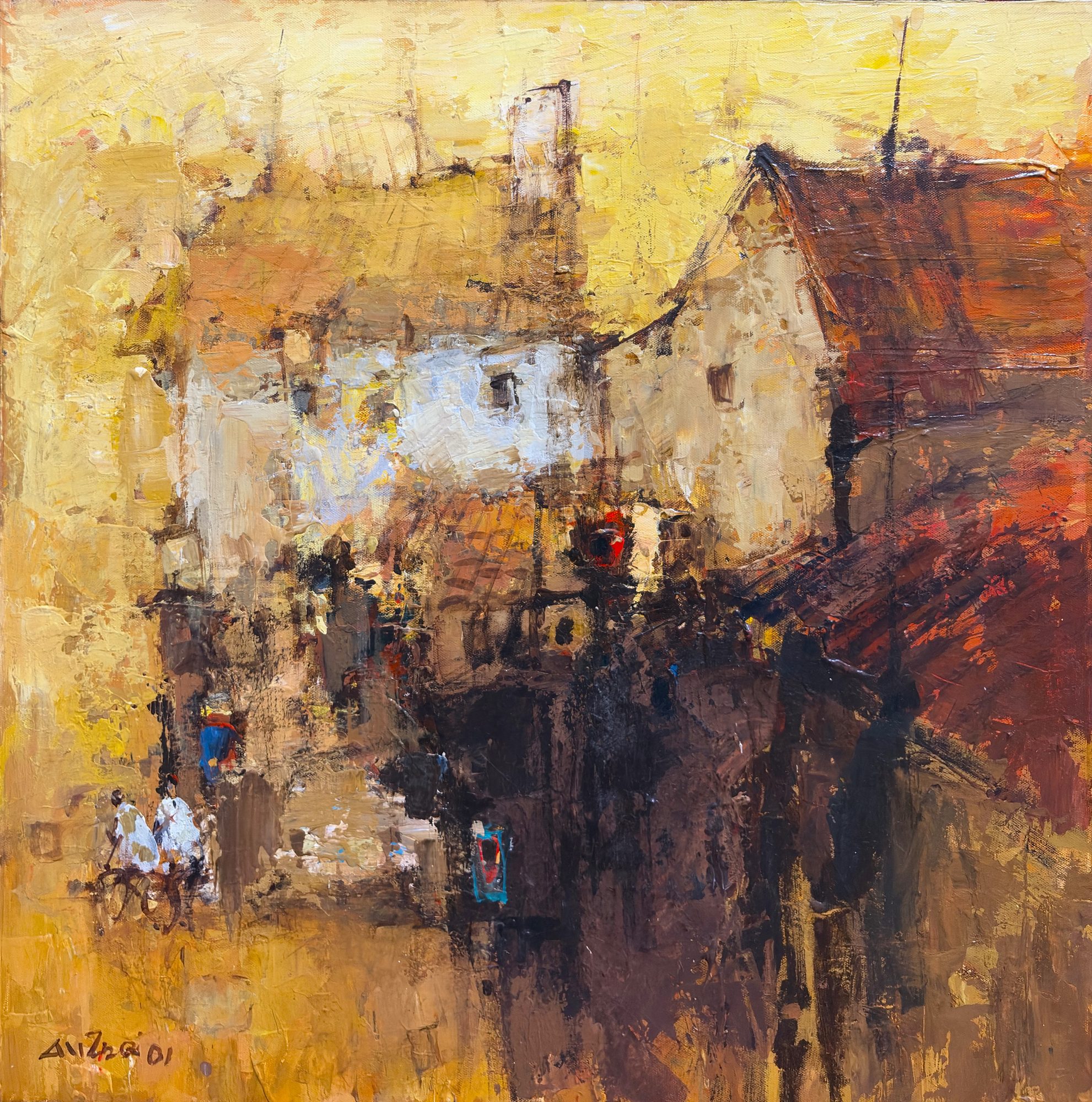
The most immediate quality of Ang Ah Tee's Chinatown is its surface. Unlike the transparent washes of watercolour or the flowing lines of Chinese ink, this painting is built through accumulation. The acrylic is applied thickly, likely with a palette knife and stiff brushes, creating ridges, scrapes, and impasto that catch the light. The canvas is not merely a support for an image; it is a sculptural object in its own right.
This physical layering mirrors the subject matter. Chinatown is a district built up over generations, with structures added, modified, and layered upon one another. The paint behaves in the same way: dark, muddy browns are overlaid with blazing yellows and stark whites, only to be scraped back or obscured by new strokes. The result is a surface that feels excavated, as if the history of the place is embedded in the material itself.
Abstraction and the Urban Fabric
The composition hovers between representation and abstraction. We can identify the sloping terracotta roofs on the right, the pale façade of a building in the center, and the dark, narrow street below. Yet these forms are not drawn; they are constructed from blocks of colour. The architecture is suggested through the collision of warm and cool tones rather than through precise outlines.
The upper portion of the painting is dominated by a glowing, almost blinding yellow, suggesting a fierce tropical sun or a sky bleached by heat. This expansive, abstract area presses down on the city below, flattening the perspective. The space is compressed, and the buildings feel dense and crowded, a sensation heightened by the lack of clear boundaries between the street, the structures, and the figures.
The city is not depicted through lines, but through layers of pigment — as if the history of the street has been pressed directly into the canvas.
— Catalogue note [source to confirm]
Colour and Light
The palette is overwhelmingly warm, built on a foundation of burnt sienna, ochre, and deep, near-black browns. The light in the painting is not the clear, directional sunlight of a watercolour like Ong Kim Seng's Chinatown (1983). Instead, it feels heavy and ambient, radiating from the yellow sky and reflecting off the central white building.
Against this onslaught of warmth, the artist introduces small, deliberate shocks of cool colour. There is a patch of cyan on a doorway or figure in the lower center, a flash of blue on a figure to the left, and a distinct red accent near the center. These cool notes provide visual relief and draw the eye down into the shadowed street, anchoring the composition.
Figures and Scale
The figures in the lower left corner are rendered in a few swift, almost calligraphic strokes of white and blue. They are barely defined — a suggestion of a person walking, perhaps a bicycle, a flash of clothing. Their presence is crucial, however, as they provide a sense of scale against the towering, chunky forms of the buildings.
Look at the figures in the lower left: they are painted with a handful of rapid, wet-on-dry strokes. They are not portraits, but punctuation marks — tiny human presences that emphasize the overwhelming weight of the painted architecture above them.
The contrast between the thick, laborious texture of the buildings and the quick, fluid strokes of the figures creates a dynamic tension. It suggests the fleeting nature of human movement against the slow, enduring accumulation of the urban environment.
Signature and Date
The painting is signed in the lower left corner with the artist's signature and the date '01. The signature is integrated into the textured surface of the street, painted in a dark colour that echoes the deep shadows of the composition, marking the work's place in Ang Ah Tee's career at the turn of the twenty-first century.
Interpretive Assessment
Chinatown is a powerful example of Ang Ah Tee's ability to merge abstraction with a deep sense of place. While earlier works in this collection might document the streets with precision or capture the play of light with transparency, this painting captures the feeling of the place through its material weight.
Its strength lies in its refusal to be merely descriptive. By pushing the medium of acrylic to its physical limits, Ang Ah Tee creates a work that feels as much like an excavated ruin as it does a bustling street. It is a reminder that painting is not just about what is depicted, but how the physical material of paint can evoke the presence and history of a place.
As with any catalogue entry, the details should be verified against reliable documentation. In particular, confirm the title, exact date, medium, dimensions, provenance and any known exhibition history before treating this interpretation as a final collection record.
Object Information and References
Catalogue data
Artist: Ang Ah Tee
Title: Chinatown [Confirm whether this is the original title]
Year: 2001
Medium: Acrylic on canvas
Dimensions: 61 × 61 cm
Provenance: [Add documented ownership history]
Exhibition history: [Add, if documented]
Bibliography
[Add publications, archival records, artist statements and exhibition catalogues used in the research.]