Composition: Houses, Bridge and Canal
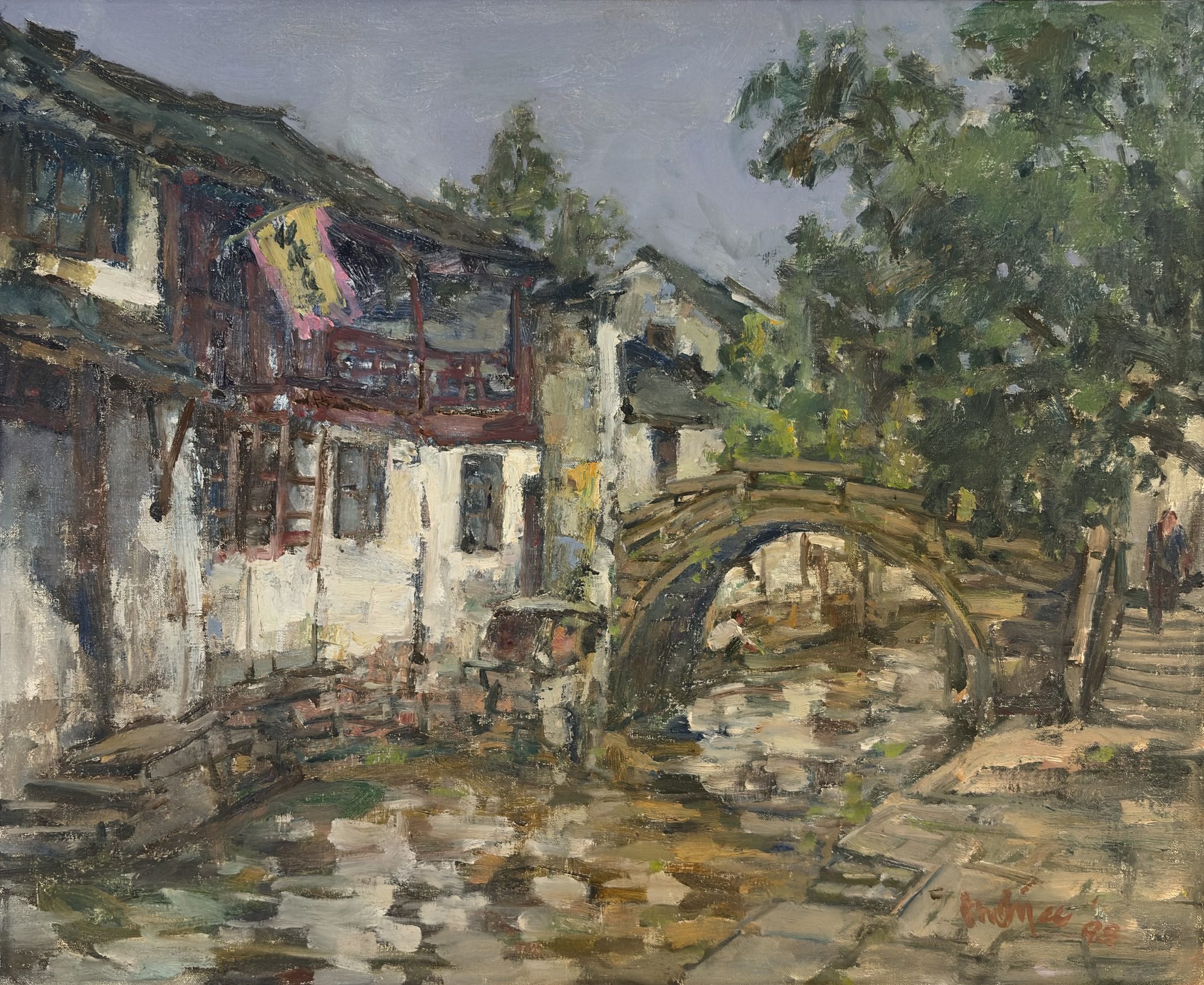
The painting is built from three masses that are read from left to right. On the left, a row of two-storey houses steps back toward the centre, their dark tiled roofs sloping across the upper edge of the canvas. A carved timber balcony in maroon and brown projects from the upper floor, and a banner of yellow and pink hangs from the eaves. At the centre, an arched bridge crosses the canal. Its dark underside is the strongest curve in the picture, and through the arch a second span can be glimpsed, suggesting that the water continues into depth. On the right, a large mass of green foliage and a flight of stone steps close the composition.
The canal in the lower third ties the masses together. Instead of a clear surface, it is broken into patches of cream, ochre, grey-green and brown that read as reflections of the houses and sky. The bridge works as the hinge of the picture: its arch repeats the curve of the foliage above it and its dark opening draws the eye into the centre of the canvas, away from the busy left side.
Colour Scheme
The sky is a flat lavender-grey, almost without modulation. It is a cool ground against which the warmer and more saturated passages of the picture are set. The whitewashed walls are not painted white: they are built from cream, pale ochre and grey-blue in shadow, so that the light seems to settle on the surface rather than glare from it. The foliage moves between olive and mid-green, with a few touches of yellow-green where light catches the leaves, and the timber of the balcony supplies the deep maroon.
The yellow-and-pink banner is the single high-key accent. Placed near the upper left, it lifts a passage of the picture that would otherwise be dark, and its pink is picked up in small touches elsewhere. The painter limits the palette to a few related hues, and the result is a scene that feels damp, quiet and slightly overcast.
Look at the whitewashed wall at the left of centre. The paint has been dragged over the canvas so that the weave shows through in places, and the wall reads as plaster, weathered and slightly uneven, without any line having been drawn to describe it.
Brushwork and Technique
The technique is direct and loaded. Strokes of thick oil are laid side by side without much blending, and the edges of forms are often established by the meeting of two strokes rather than by an outline. The roofs and timber balcony are pulled down in long, dark strokes; the foliage is built from short, broken touches in several greens; and the water is handled in horizontal, slab-like marks that flatten the surface into a pattern of reflections.
The sky is thinner, and its scumbled surface lets the canvas show. This contrast between thin sky and heavy architecture gives the picture its weight: the buildings feel dense and physical while the air above them remains empty.
Figures and Scale
Two small figures give the scene its scale. Beneath the arch, close to the water, a figure in a white shirt crouches at the canal's edge, reduced to a few strokes of light. At the far right, a standing figure in dark clothes appears at the top of the stone steps. Neither figure is described in detail, yet both establish the human scale of the bridge and the working life of the canal.
Signature and Date
The painting is signed in the lower right in red-orange paint, followed by the date, which reads '98. The red-orange of the signature stands out against the grey-brown paving and echoes the maroon of the balcony on the opposite side of the canvas, so that it works as a final accent as well as an identification.
Interpretive Assessment
Street Scene shows the strength of Tan Choh Tee's approach to a canal town subject: a few large masses, a tightly controlled palette and a thick, confident touch. The picture does not describe every window or tile; it selects the arch, the balcony, the tree and the water, and trusts the brush to supply the rest.
The catalogue details and context should be completed from reliable documentation. In particular, confirm the title, the location depicted, the date, the dimensions, provenance and any known exhibition history before treating this interpretation as a final collection record.
Object Information and References
Catalogue data
Artist: Tan Choh Tee [Add Chinese name]
Title: Street Scene [Confirm whether this is the original title]
Year: 1998
Medium: Oil on canvas
Dimensions: 53.5 × 65 cm (height × width)
Location depicted: [Confirm]
Provenance: [Add documented ownership history]
Exhibition history: [Add, if documented]
Bibliography
[Add publications, archival records, artist statements and exhibition catalogues used in the research.]